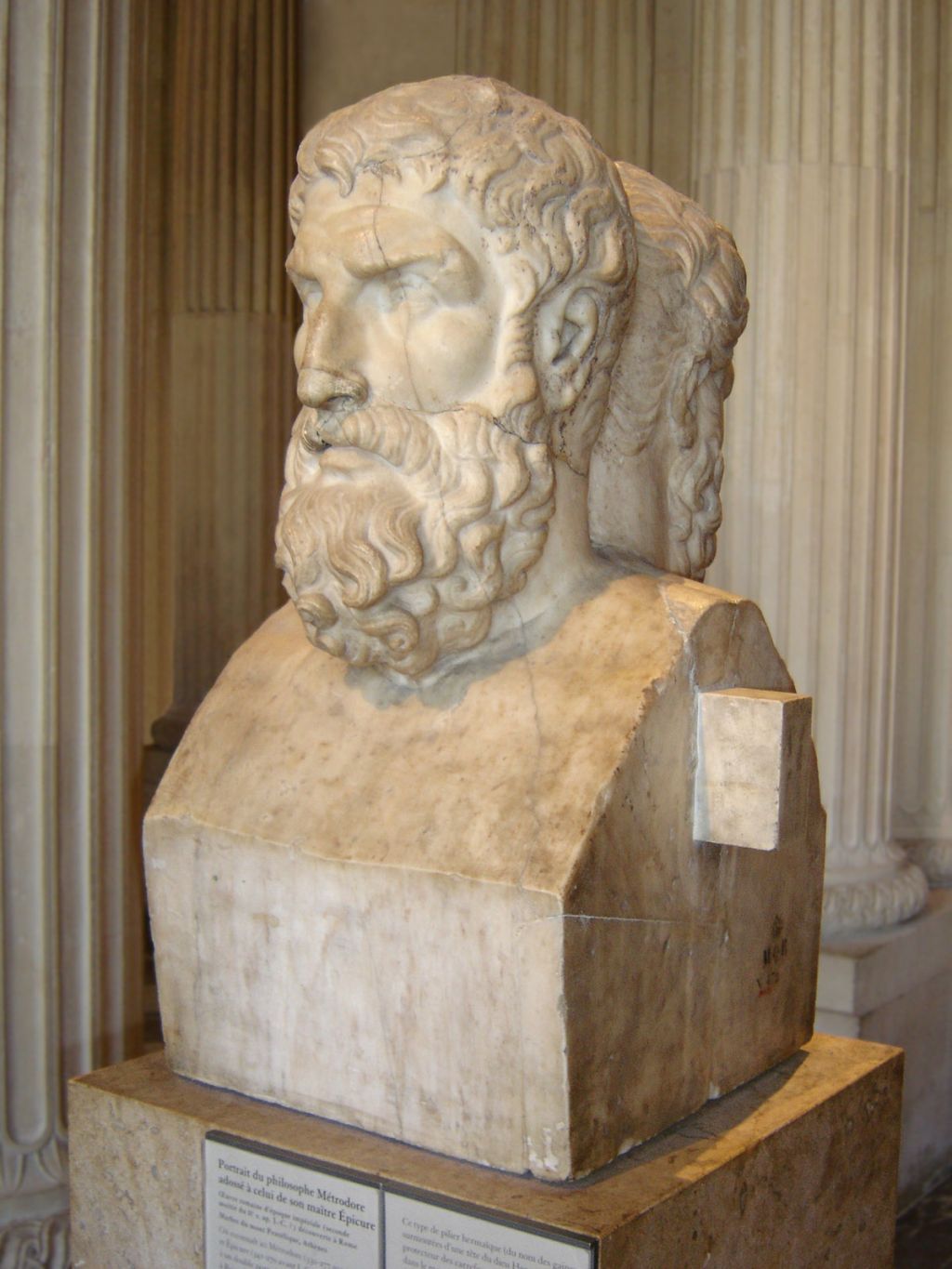
Atomism, Democritus and Epicurus
In the Atomists, we see pluralism taken as far as it could possibly go. We see Democritus and Epicurus divide all the world, as well as the universe, into two categories; atoms and empty space. Everything else is merely thought to exist. The atoms are eternal, infinite in size and number and they are moving through the empty space. There is no motion without empty space. Both Democritus and Epicurus agreed that motion was impossible in a plenum, but it is here that their theories diverge. In the cause of the motion, we begin to see a variety of opinions.
Both Democritus and Epicurus agreed that the "qualitative world of sense perception arises from the motion of qualitatively neutral atoms. They believe that the immense qualitative variety results from the 'jostling' of atoms...as they collide and bounce apart, and so, constantly form new groupings" (Jones 84). They believe it to be a mechanical process occurring completely by chance. Furthermore, although new groupings are constantly being formed, only the few that can survive are considered the "right" combinations. These are the combinations we recognize through our senses as being "real", although they are not. However, the way in which this complex motion begins is a source of controversy and disagreement amongst the Atomists.

Democritus assumes that the atoms' motion is perpetual. The atoms are never at rest. He presumes that their nature is to move, thereby avoiding "the problem of explaining the origin of the complex motion of atoms by simply affirming that it is in their nature to move so" (Jones 85). He believes that atoms are born along with the whole universe in a vortex. The vortex is not an outside influence, but rather the motion of the atoms themselves. He never accounts for the initiation of this motion.
More Classical Philosophy
essays:
Sophists to Socrates.
... the human nature of difference. Relating to the phenomena of sense perception, understanding this can only be captured in diving into deep ... conversation, they had progressed from a broad definition to the universal meaning. Constantly, Socrates insisted on his own ignorance. By doing this, he ...
Review of Bimal Krishna Matilal?s essay ?A Realistic view of Perception?
... defines sense perception as that1.which is produced by the contact of the object with the sense organ2.Which is not expressed in words3.which is non erroneous4.which is well defined. Taking 1 as a constant starting ...
Atomism
... etc., atoms do not have them - an atom cannot be yellow, or salty. 4. Democritus's atomistic universe: atoms move about in the void (empty space), collide ...
The Concept of the Happy Life; A Comparison in Epicurean and Stoic Philosophies
... sense perceptions (Mannion, 31). The Epicurean outlook is that we should seek pleasure and avoid pain, and no matter how noble a conquest may seem, the true motivation for action lies in achieving pleasure for oneself (Mannion, 32). According to Epicurus ...
Aristotle's Wisdom
... our senses because they bring us knowledge of the world outside ourselves. Knowledge is thus rooted in sense impression. Some animals are only capable of sense perception. Others ...
Thomas Aquinas’s Works and Philosophies As an Italian philosopher and
... as universities were founding Aristotelian corpus, the relation between faith and reason, was called into question (Stanford Encyclopedia of Philosophies). Aquinas created his own philosophies on sense perception and ...
Sense and Reference
... explanation of a word's sense. But since words obviously do need further explanation, often the idea of a universal sense is not supported. With ... Back Quick/Bitch Be Quiet/Ball Busting Quiz and many others) could ultimately result in a different chain of events or at minimum confuse/distort or ...
Is nature; hostile, benign or neutral? The effects of nature on humans and other species.
... molecules then nature cannot possibly be assigned into one single group, whether it is benign, neutral or hostile. It may be an unstable environment but it ... the result of a foreign object from space or the result of ...