Blaise Pascal was born in Clermont France on June 19, 1623, and
died in Paris on Aug. 19, 1662. His father, a local judge at Clermont, and
also a man with a scientific reputation, moved the family to Paris in 1631,
partly to presue his own scientific studies, partly to carry on the education of
his only son, who had already displayed exceptional ability. Blaise was kept
at home in order to ensure his not being overworked, and it was directed
that his education should be at first confined to the study of languages, and
should not include any mathematics. Young Pascal was very curious, one
day at the age of twelve while studying with his tutor, he asked about the
study of geometry. After this he began to give up his play time to persue the
study of geometry. After only a few weeks he had mastered many properties
of figures, in particular the proposition that the sum of the angles of a
triangle is equal to two right angles.
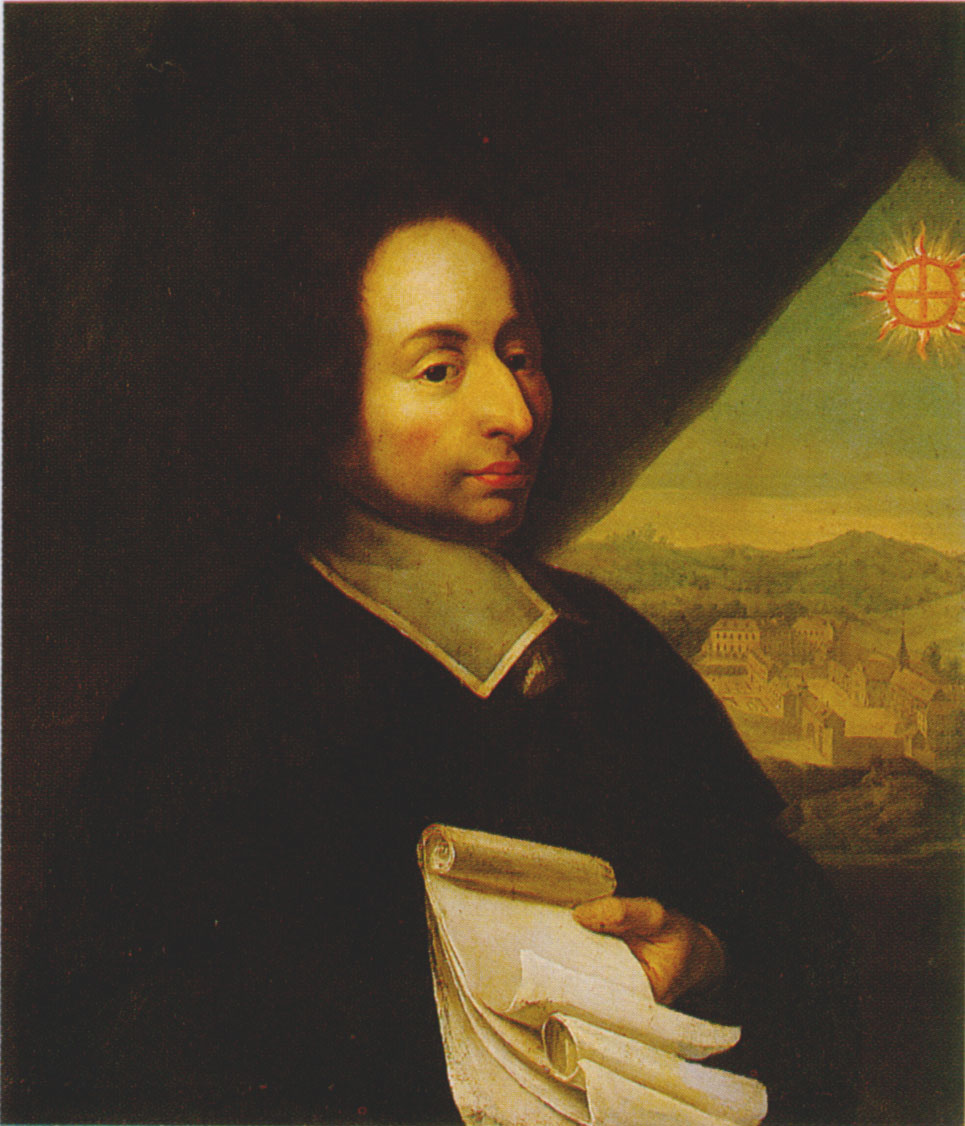 Portrait of Pascal
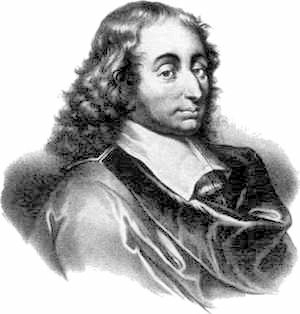 Blaise Pascal first explained his wager in Pensée...
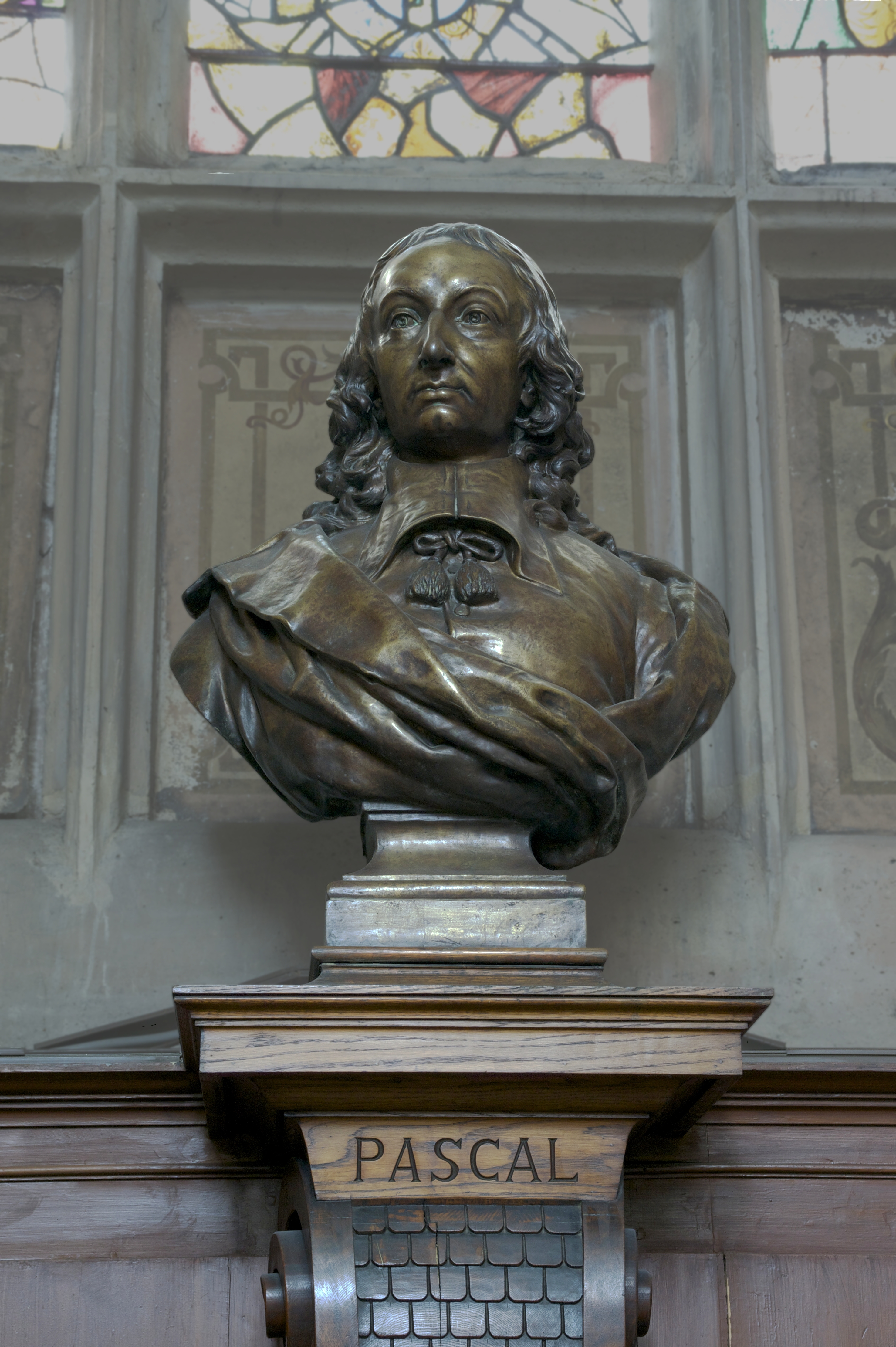 English: Bronze bust of Blaise Pascal, 19th centur...
His father noticed his sons ability in
mathematics and gave him a copy of Euclids's Elements, a book which
Pascal read and soon mastered. At the young age of fourteen he was
admitted to the weekly meetings of Roberval, Mersenne, Mydorge, and
other French geometricians. At the age of sixteen he wrote an essay on
conic sections; and in 1641 at the age of 18 he construced the first
arithmetical machine, an instrument with metal dials on the front on which
the numbers were entered. Once the entries had been completed the answer
would be displayed in small windows on the top of the device. This device
was improved eight years later. His correspondence with Fermat about this
time shows that he was then thurning his attention to...