Borderline Personality Disorder � PAGE �1�
Running head: BORDERLINE PERSONALITY DISORDER
Borderline Personality Disorder Within the Adult Population: A Brief Overview
By Xxxxxx Xxxxx Xxxxx
Submitted to Xxxxx Xxxxx in partial fulfillment of NR XXX
Regis University
February 1, 2008
�
Borderline Personality Disorder Within the Adult Population: A Brief Overview
Borderline Personality Disorder (BPD) is a prevalent and chronic personality disorder that has both biological and environmental components that contribute to its development. It is said to be an aberrant condition of the self-structure or an identity disturbance (Gregory, 2007). Prominent characteristics include impulsivity, self-injury, destructive relationships, and emotional lability. Patients with this diagnosis can be paranoid, suicidal, empty, and depressed. They often demand attention and show great fear of abandonment. Individuals with BPD have very often experienced severe abuse, neglect, invalidation, or trauma during their childhood. As a result, these individuals are not only exposed to examples and patterns of maladaptive behavior, but they also develop maladaptive strategies in order to cope with the immediate stressor.
 The Image illustrates dissociation in the field of...
 This flow diagram illustrates the development of B...
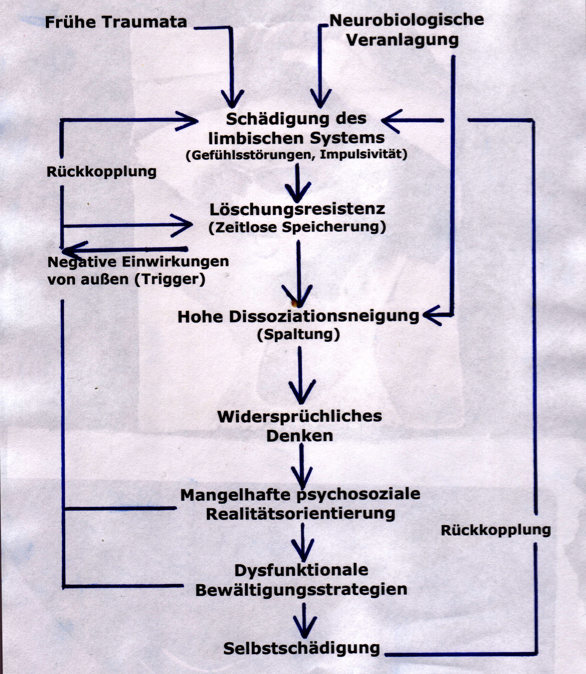 This flow diagram illustrates the development of B...
Unfortunately, these behaviors perpetuate and result in emotional dysregulation (Nelson-Gray, Mitchell, Kimbrel & Hurst, 2007).
Borderline personality disorder is a debilitating condition that often requires utilization of psychiatric and medical resources (Clarkin, Levy, Lenzenweger et al., 2007). Additionally, many individuals diagnosed with BPD may have comorbid disorders such as, major depression, anxiety, and chemical dependence, which only confounds the problems (Sharp, 97, 2007). In the United States, 2% to 3% of the general population is diagnosed with BPD. Females are three times more likely to be diagnosed with BPD than are males, possibly because women may be more biologically predisposed, they may feel pressured by sociocultural expectations, and because similar signs and symptoms seen in the male population usually lead to the diagnosis of narcissistic personality disorder instead of BPD (Stuart, pg...
May be well done
actually i m not clear about the topic...i think u explain it in a difficult way, which is little bit hard to understand.
0 out of 0 people found this comment useful.