A Brief Discussion of Judaism
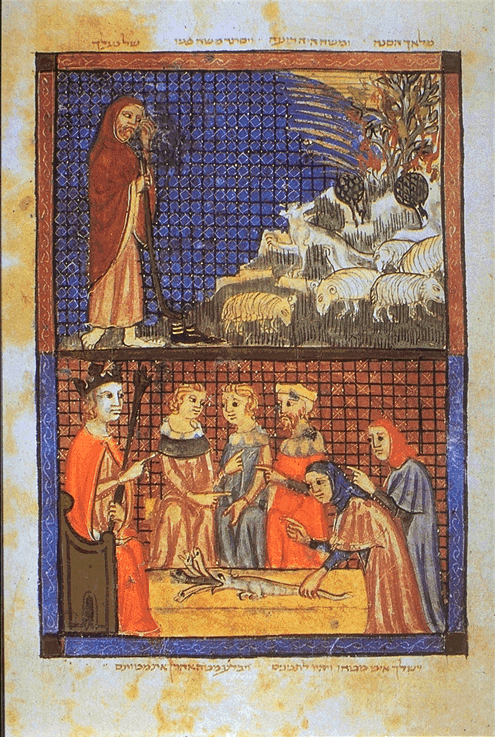
Judaism is a religion that has been around for many years, since the time of Moses, ca. the thirteenth century B.C. That was the time in which God designated the Hebrews as His chosen people, brought them out of slavery in Egypt to the Promised Land (what is now Israel), and bestowed on them the stone tablets on which were inscribed the Ten Commandments. The book of the Bible that portrays this flight is that of Exodus. Many scholars debate on how literally this chapter of the Bible can be read. For the most part, it is considered to be a literal text, however there is some debate on the exactness of things such as the ten plagues, the 'hardening of pharaohs heart', and the Lord speaking personally with Moses.
The first four chapters of Exodus deal with Moses' upbringing, and his call by God to be His prophet. At the time when Moses was born, the Pharaoh commanded that all male Hebrew babies must die. Moses' mother hid her son for three months before floating him down the Nile, where Pharaoh's daughter found him, and adopted him for her own son. Therefore, Moses grew up in the court of Pharaoh, along with Pharaoh's son, the one whom Moses would later speak to on the behalf of God. Chapters five and six deal with Moses' conversation with Pharaoh.
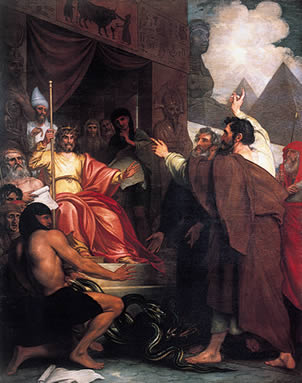
The most disputed fact in Exodus is that of the hardening of Pharaoh's heart, which occurs in chapter seven. The idea that God gave Pharaoh no choice in the matter goes against a huge truth that exists in both Judaism and Christianity - that man possesses free will. The problem lies in that if man has free will, then how can God make Pharaoh obstinate? Wouldn't that make Him a dictator? A...
More Religion & Faith
essays:
A Brief Discussion of Islam and the Book 'Understanding Islam' by Thomas W. Lippman
... bring the faithful together and lead to the Promised Land. However, I think that because the Koran ... was the man to whom God revealed the Koran, the holy book of Islam. The Koran is meant to be read literally, which has made for some hardships through the centuries. There ...
A Brief Discussion of Hinduism and the Hindu Religious Book 'The Bhagavad-Gita'
... to interpret it, would it really be that way? Technically speaking, we are composed of real things, existing things, things with mass and area. I believe that God created us, the world, and everything in it out of nothing. If so ...
A Comparitave Report on Christianity and Judaism in relation to Abortion and Aboriginal Rights in Australia.
... of the dignity of the person and therefore works in favour of the common good? Such questions are more than theoretical when we consider an issue as concrete as the reconciliation of the Aboriginal people of your land with ...
The traditional (pre 1788) Australian Aborigines had a positive view of the world, while the Buddha had a negative view of the world. Discuss the validity or otherwise of this statement.
... to the land, to kin and the Dreaming. Generally it was an object or creature that helped to provide Aboriginal people with a link to their country. Customary law outlined the responsibilities to a persons ...
What is a Belief System?
... precepts. The Nicene Creed (A fourth century confession of faith) is used at every mass. The Nicene Creed summarizes the belief of the Catholic Church and my personal beliefs ... from the Father and the Son. With the Father and the Son he is worshiped and glorified. He has spoken through the prophets. We ...
A paper discussing Christianity, Judaism, and Islam, and how aspects of each religion has affected general social behavior. "History of God" by Karen Armstrong as reference
... implies the ability to enforce the laws being handed down. In Judaism, the concept of an anthropomorphic God has led to several beliefs. The belief that Jews are the Chosen People has ...
Judaism, Christianity, Islam: One God? A Comparison of Modern Western Religions
... power: Moses. Moses convinced Pharaoh to let his people go by unleashing ten plagues upon the land, the last of which killed the oldest born children of Egypt. Moses led the Hebrew people out of slavery and ...
Judaism
... told Moses to go to the Egyptian Pharaoh and tell him, "Let my people go." When the Pharaoh refused God sent ten plagues to the Egyptians. The final plague brought ...