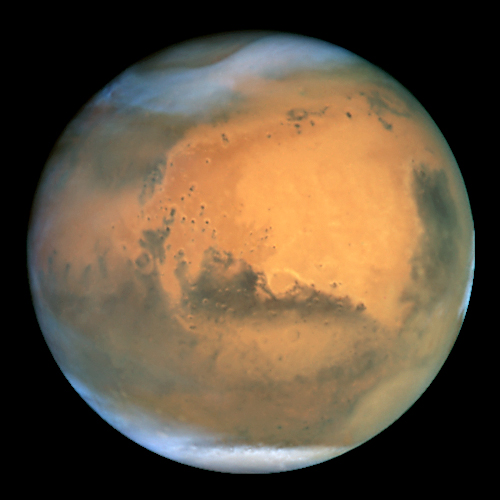
Brief essay about the planet Mars. 596 words. Detailed about the surface of the planet, surroundings, and atmosphere.
The atmosphere above the surface of Mars is about 100 times less dense than the atmosphere of Earth. The Martian atmosphere is dense enough to support a weather system that includes clouds and winds. According to experts, Mars' roller coaster-like weather is more chaotic and unpredictable than scientists first thought. At times, the sky can appear pink and cloudless, filled with windblown dust raised from the rusty Martian surface. Tremendous dust storms sometimes rage over the entire planet. Most of the dust storms occur during the perihelion - when Mars is closest to the sun. In addition, the dust storms continue to dominate the atmosphere and climate during the aphelion - when Mars is furthest from the sun. Perihelion and aphelion occur every Mars year, which equals two Earth years. (Mars Atmosphere, 2002)
Mars is much colder than Earth. The average temperature on Mars is about -80 °F (-60 °C).Temperatures at the Martian surface vary from as low as about -195 °F (-125 °C) near the poles during the winter to as much as 70 °F (20 °C) at midday near the equator. (Mars Science, 2000)
These shifts in climate are caused by three factors: Mars' thin atmosphere, its elliptical orbit around the sun, and strong climatic interactions between dust and water ice clouds in the atmosphere. Mars' atmosphere is so thin that it weighs less than 1 percent of Earth's atmosphere. Because Mars' atmosphere is so paper-thin and there are no oceans to store up heat from the sun, the planet's temperatures respond more quickly and intensely to surface changes and atmospheric heating by the sun. There are also much larger annual changes in sunlight falling on Mars than on Earth, because Mars' distance from the sun varies by 20 percent in its orbit around the sun every two...
More Space
essays:
UFO's, Fact or Fiction?
... a Martian mesa in precise alignment to the sun and to surrounding structures' (Arvey 45). Hopefully continuing expeditions to Mars will help to unlock ... were the] caskets that we could furnish that were hermetically sealed.' At first, thought the call was a prank, but as it drew on, he began to take ...
Women's Contributions to Aeronautics and Space: Historical Milestones
... begun to make their mark, not just in support roles, but also, as pioneer engineers, scientists, pilots, mathematicians and technicians. The contribution of women to the mission of the National ...
The Effects of Space Exploration on Modern Society
... about the atmospheres of the planets in our solar system. Scientist and environmentalists have learnt a great deal about our planet. With the help of satellites, they can now easily find facts about deforestation, pollution, global warming and climates, giving ...
The Evolution of a Habitable Planet
... weather evolve and stabilize? How did its atmosphere and air develop? How does Earth have enough breathable oxygen? And lastly, how do we, along with other organisms survive without getting burned by the sun's ultra-violet rays? The answers to ...
Life Outside Our Biosphere
... Venus, the second from the sun. This 'sister planet' of Earth proved to have extremely hostile conditions. Scientists were hopeful when they found traces of water vapor in the upper atmosphere, but ... solar system, a few planetic possibilities exist for colonization. Mars, one of our closest neighbors ...
Space Exploration. Is space exploration worth it? How Mars can help people if it was terraformed.
... on Earth that enough oxygen was produced to allow for the development of animals. Similarly, the thin Mars atmosphere today is almost totally composed of carbon dioxide. There are a few Martian features ...
Mars Funding
... people to want to learn more about space, earth and ourselves. Donald S. Brown from USA Today argues "The successful landing of the Spirit rover on Mars is a wonderful New Year's gift to the NASA ...
EXPANSION TO MARS PAPER!! This tells about what they plan to put a colony on Mars
... where Mars is the closest to the Earth. This makes it difficult to observe details on the surface. Scientists, however, have found out that Mars is suitable for humans to expand to after a few adjustments of the atmosphere. Moreover ...