Comparison of Islamic text and movies.
I find many differences in the interpretation of historical events between the film "Islam: Empire of Faith," and Hodgson's The Venture of Islam text. I also think that both the film and the text have similar messages, though their makers have chosen to show the messages differently.
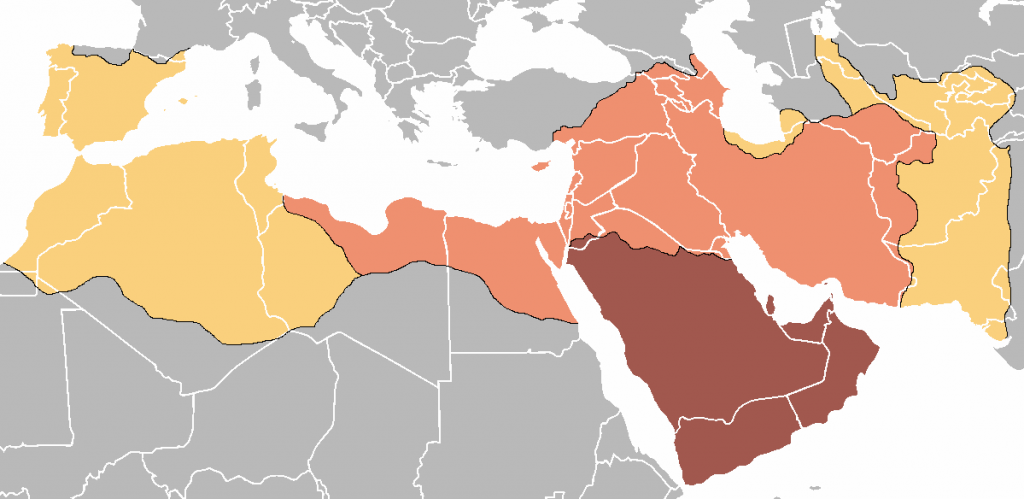
The film runs more like a work of fiction, a tale from out of One Thousand Arabian Nights perhaps, than a traditional PBS film. I almost forgot to take notes because I was watching the film so intently, fully immersed into the goings-on of Muhammad and the Muslim people. The text, on the other hand, is more concerned with dates, maps, names, and smaller details. The film and the text go hand-in-hand, even if their interpretations of historical events are different; one should watch the film for the overall effect of the Islamic Empire, but one should read the text for specific information about what happened when and why it happened.
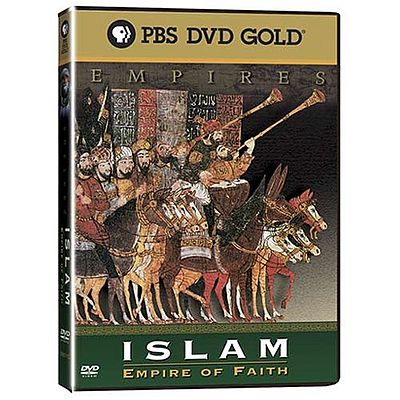
The film's emphasis is not necessarily on the Muslim faith, but more on what the Muslims contributed to the world in the ways of science, math, art and architecture. The film also depicts major battles, like those of Muhammad against the Bedouin pagans. Conversely, Hodgson pays close attention to the religion, and acknowledges several times that it was at the base of the Islamic Empire, saying, "We shall be talking a good deal about religion in this work, for it pervaded every aspect of Islamicate culture. I must make clear my point of view on it," (Hodgson, I: 158).
Hodgson seems to interpret events in a linear fashion, with times and places and terminology at the heart of his writing--this can be found throughout the book, especially in the General Prologue to book I on page 71. "Islam: Empire of Faith" depicts...
More Middle Eastern History
essays:
Exaggerated Representations of Kings Saladin and Richard I and How These Representations Reflected the Cultures and Values of Their Times
... Book of Islam), a leader (even in war) must remain merciful show restraint, even unto his most bitter of enemies. Clearly, Saladin's actions during this time were an ideal reflection of the values widely held by the Muslims of the ...
Empathetic diary entries of a Deir El-Medina tomb worker. Includes information of both high and household ancient Egyptian gods as well as everyday life.
... yet chosen a name, however I have faith that Takota will choose wisely. I was impressed with my eldest son's drawings today. He had drawn a monkey stealing figs from an orchard on a flake of limestone. Rather amusing. My ...
Compare and contrast the 1990 Gulf War to the 2003 Iraq invasion. Did the position of Arab regimes differ?
... relations, Routledge, New York, 1993. Reilly, Marc J., Unexceptional America: Empire in the Persian Gulf, 1941-2007, Lexington Books, New York, 2008. Seliktar, Ofira, The politics of intelligence and American wars with Iraq, Palgrave Macmillan, New York ...
History of Turkish Occupation of Northern Kurdistan.
... treaty of Lousanne, Mustafa Kemal Ataturk proceeded to integrate the country and start a process of Westernize the once orthodox Islamic empire. Kemal ... Georgian forces in eastern Anatolia. These forces were defeated by almost entirely Kurdish armies, who thought they were fighting for a ...
"A Marxist View on Government and Religion of Ancient Egypt and Mesopotamia"
... and puts all the people on the same level. Everything is equal. When looking back at the government and religion of ancient Egypt and Mesopotamia, a Marxist would realize that these two civilizations are not suitable for Marxism. Marxism is a ...
Difference between Sephardic and Ashkenazi Judaism
... period of muslim domination of Spain. While there aren't many records of Jews as a community taking historically important actions in the course of their stay in the Ottoman Empire, many ...
The History of Iran, Turkey, and Iraq. This essay represents the notes of a History course about the countries of the Middle East.
... posts of Sultanate and Caliph in 1924. M. Kemal was an ardent secular nationalist without religious faith. He believed that all Ottoman Empire inheritance ...
Constitutional Revolutions of Iran and Turkey in the 19th Century.
... the general public. Although many sustained the inherit belief of Muslim superiority, the general consensus would be that the minority groups of the empire should ... declared Tobacco Concessions of 1891 as "un-islamic". This concession would later be retracted by the Shah as a result of public opinion. ...