A Comparison of Plato and Aristotle.
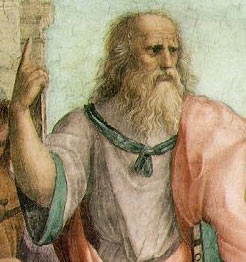
Plato and Aristotle, two philosophers in the 4th century, hold polar views on politics and philosophy in general. This fact is very cleverly illustrated by Raphael's 'School of Athens' (1510-11; Stanza della Segnatura, Vatican), where Plato is portrayed looking up to the higher forms; and Aristotle is pointing down because he supports the natural sciences. In a discussion of politics, the stand point of each philosopher becomes an essential factor. It is not coincidental that Plato states in The Republic that Philosopher Rulers who possess knowledge of the good should be the governors in a city state. His strong interest in metaphysics is demonstrated in The Republic various times: for example, the similes of the cave, the sun, and the line, and his theory of the forms. Because he is so involved in metaphysics, his views on politics are more theoretical as opposed to actual. Aristotle, contrarily, holds the view that politics is the art of ruling and being ruled in turn. In The Politics, he attempts to outline a way of governing that would be ideal for an actual state. Balance is a main word in discussing Aristotle because he believes it is the necessary element to creating a stable government. His less metaphysical approach to politics makes Aristotle more in tune with the modern world, yet he is far from modern.
Plato's concept of what politics and government should be is a direct result of his belief in the theory of forms. The theory of forms basically states that there is a higher 'form' for everything that exists in the world. Each material thing is simply a representation of the real thing which is the form. According to Plato, most people cannot see the forms, they only see their representation or their shadows, as in the simile of...
More Comparative Philosophy & Ethics
essays:
The Views Of Reality Of Plato and Aristotle
... rules of science, and thus this created the all famous Plato and Aristotle Dichotomy. Plato Plato's work is very famous, and his theories are sometimes used in novels, soap operas, and movies. Plato, the older of these two philosophers, was ...
A study on Plato, Aquinas, Anselm, and Pascal.
... that philosophers write primarily for other philosophers. As a result, philosophy articles are sprinkled with jargon and references to hard issues. Apology: A Defence of Socrates, by Plato. Plato is ...
Compare and contrast Parmenides' and Plato's different views of reality. Which theory do you find the most convincing?
... neither philosopher succeeds in entirely convincing me. The logic behind Parmenides' 'it is or it is not' is impeccable yet parts of Plato's ... and metaphysical assumptions. He argues that the material world is merely an imperfect resemblance of an absolute, non-corporeal reality of Ideas, of Forms ...
Plato and Aristotle: Emphasis on the 2 world vs 1 world.
... because Aristotle was more interested in understanding the nature of experience, he made a model explanation for the universe while Plato didn't seem to care. A final difference between these two philosophers is how they view humans ...
Socrates, Plato and Aristotle cannot be considered as members of a same philosophical movement.
... Socrates, Plato and Aristotle each had their own ideas and direction with their philosophy and had different directions in their thinking. Socrates, the first of these great philosophers was ...
Philosophies of Socrates, Plato, and Aristotle
... Socrates, Plato, and Aristotle The philosophies of Socrates, Plato, and Aristotle had different points of-view but they were also similar in some ways. For example, all three philosophers had their own thoughts on the subject of justice ...
What is Philosophy? according to Plato, Pieper, and Thoreau.
... and philosophical maturity during the middle of the twentieth century -- some of whose early works were confiscated by the Nazi government -- he ultimately developed a wider following of readers interested in his philosophy in ...
"The Idea of Good in Teachings of Different Philosophical Schools" (based on the Internet sources)
... understanding of the concept of good. Philosophy could present several possible definitions of good. The school of Epicurus makes very unusual presentation of what good is. From a traditional point of view, pleasure ...