'Could the Greenhouse Effect Cause More Damage?'
John Harte is an ecologist from the University of California at
Berkley. He is trying to find out whether heat stimulates further
trace-gas from solid or not. He is going to conduct an experiment that
will tell him if the greenhouse effect could start a cycle that would cause
the effects to be worse than already predicted. The experiment will begin
December of 1996 and will run for no less than three years.
Harte has stretched a twelve foot high grid of cables above 300 square
yards of land in a high mountain meadow in the middle of the Colorado
Rockies. The cables are supported by four steel towers, one at each
corner of the grid. Hanging down from the cables are ten infrared heat
lamps which are about three feet long each. This is supposed to simulate
what many see as the coming apocalypse.
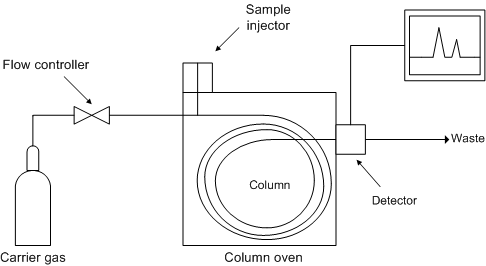 Diagram of a gas chromatograph.
 Bret Harte
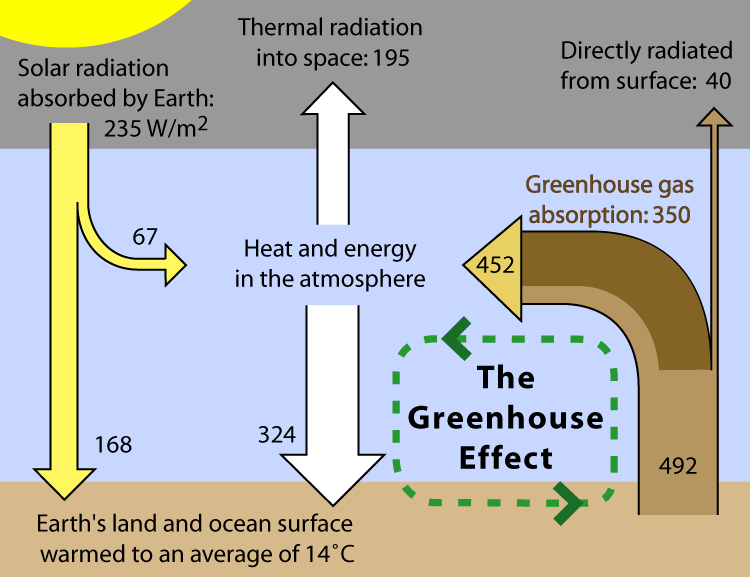 Greenhouse Effect
(global warming) 'By 2050, if we
decide to load trace gasses - mainly carbon dioxide - into the atmosphere
at our current rate, we can expect Earth's temperature to increase by any-
where from three to nine degrees. The Vostok record confirms that,'
says Harte.
The grid is divided into ten sections. Each of the ten sections covers
thirty square yards of the meadow. The infarared lamps will heat every
other section by 2.5 degrees. The unheated sections in between allow
researchers to compare the efects of the lamps with the regular state of
the meadow.
One time a week, Harte will take gas samples from buckets turned
upside down for ten minutes at a time on both the heated and unheated
strips through fitted nipples at the bottoms of the buckets by syringes,
then analyze them with a gas chromatograph. 'We'll be able to plot any
changes in the meadow very precisely,' says Harte.
Some of these changes could alter the very make-up of the seasons.
With a 2.5 degree rise in temperature, snow at high elevations might
melt up to two months sooner. In Colorado that would constitute March
as May. As a result, the soil will dry quicker and will be much warmer
than usual when May rolls around. John Harte says it would be like
expanding summer at the expense of winter.
That means plants that usually start to bloom just as the snow begins
to melt will bloom sooner then the pollinators of those plants can get to
them. That would be harmful to both of the species involved. Harte says
that this project should confirm that people don't have any time to waste
when it comes to saving this disaster from happening.
In three years, Harte and other researchers will be able to tell
whether or not Global Warming will be the next apocalypse. This apparently
is a serious issue to many environmentalists and ecologists. A lot of time,
money, and effort is being put into this. If this experiment ends up
warning us about what may happen if people keep polluting the atmosphere
with certain gasses, Harte and other researchers working on this project
will be commended.