By investigating our solar system we broaden our perspectives and increase our understanding of the workings of the universe in broad-spectrum. An admirable approach to explore worlds is through comparative planetology, where we gain knowledge of a planet in context or comparison to another. Each planet has its own unique characteristics due to the span of time in which the structural processes have taken place. Many geological features of the planets are the result of chemical and physical processes whose function's occur elsewhere in the universe.
Earth is a supreme model for which to provide a basis for comparative planetology. Astronomers have conquered Earth and gathered an immense amount of knowledge about our home planet, therefore making it a suitable reference for contrasting with other bodies in our solar system. Utilizing seismic waves, researchers have been able to determine the interior composition of our planet. Examination of outer lying rocks, gravity measurements, and studies of planetary magnetic fields also provide various clues about the internal structure of planets.
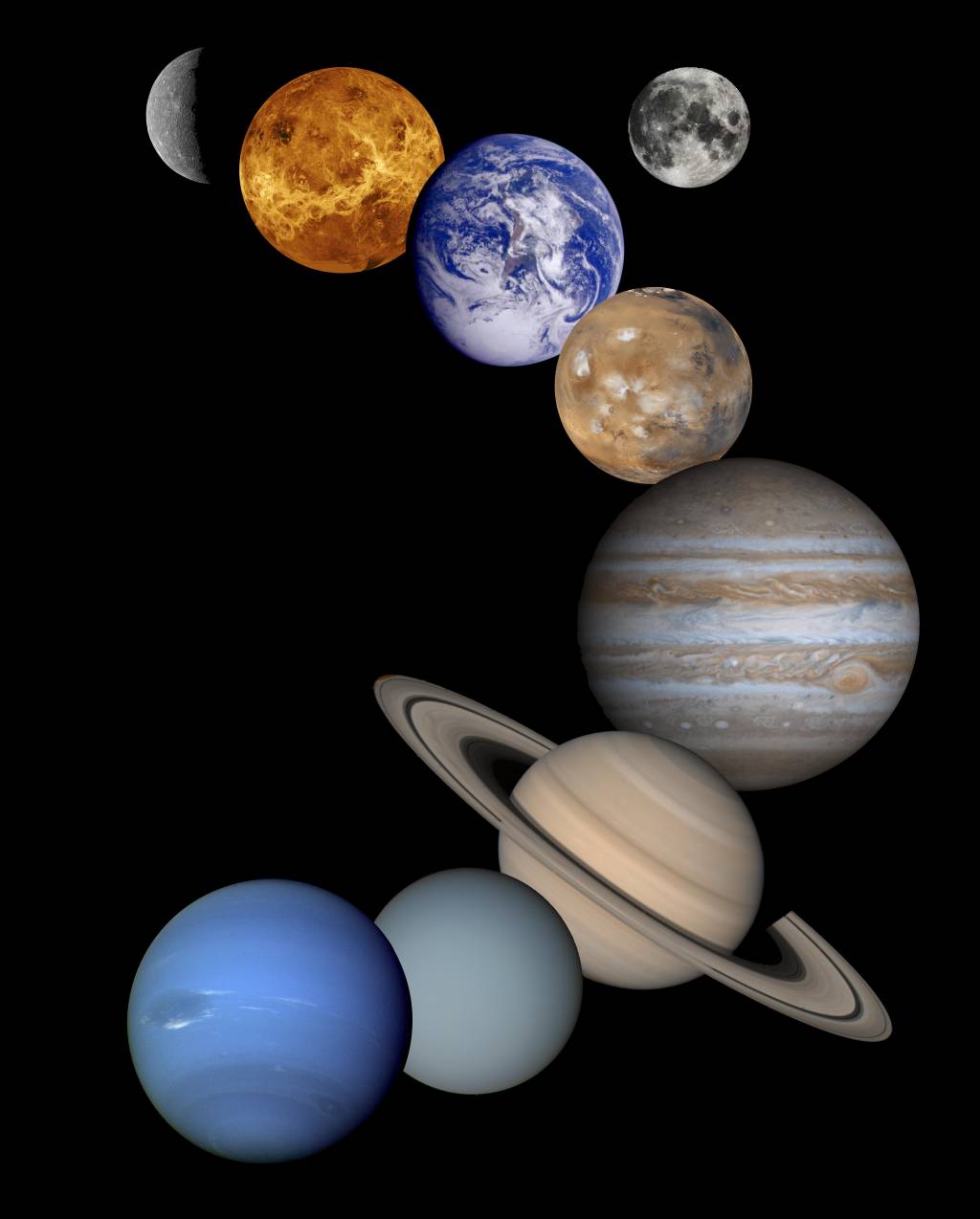 Planets of the Solar System
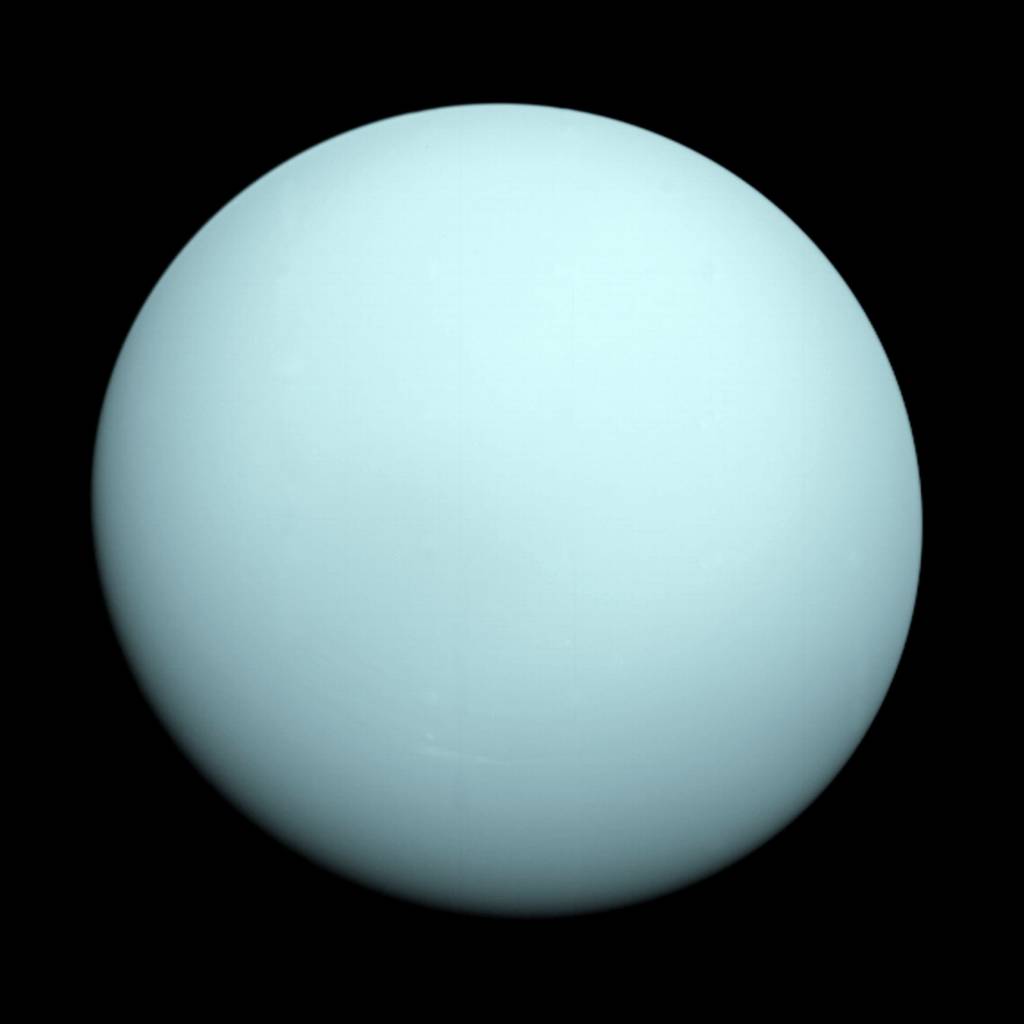 English: This is an image of the planet Uranus tak...
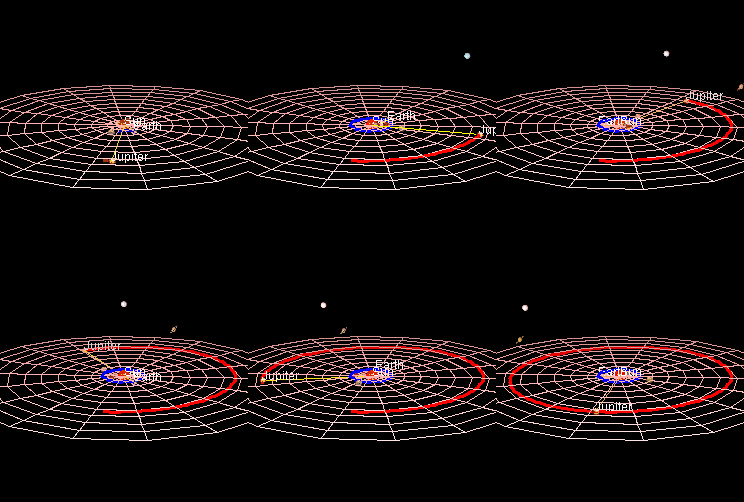 English: plane of the ecliptic of the Earth's orbi...
We now know that Earth, as well as many other terrestrial worlds, contain three basic layers: a core, mantle, and crust. There is also a layer known as the lithosphere which typically blankets the crust and a portion of the upper mantle.
Our planet has undergone remarkable changes since its inception billions of years ago. Many processes have carved the Earth's surface throughout its history; those same practices are currently taking place beneath our feet everyday. The four major perpetrators shaping our world include:
Erosion: the wearing down or building up of geological features by wind, water, ice, and other phenomena of planetary weather.
Impact Cratering: the blasting of bowl-shaped impact craters by asteroids or comets striking a planet's surface.
Tectonics: the disruption of a planet's surface by internal stresses.
Volcanism: the eruption of lava from a planet's interior onto its surface.
These same factors are also responsible for the formation of surface features on other planets in our solar system.
Mercury is the closest planet to the Sun and second smallest planet in the solar system. Its diameter is 40% smaller than Earths; Jupiter's moon Ganymede even dwarfs it in size. Mercury's dust-covered hills have been battered as meteors and asteroids are constantly beating it, while fault-cliffs ascend in height for several kilometers and extend for hundreds more along its surface. Mercury rotates one and a half times during each orbit, and one day on Mercury is equivalent to one hundred and seventy-six days on Earth. Mercury possesses no moons or rings.
Venus is the second planet from the Sun and it is also the sixth largest. Venus' rotation is somewhat bizarre, in that it is both very sluggish and retrograde. Venus is often denoted as Earth's sister planet; however, it is composed mostly of carbon dioxide and has several layers of clouds containing mostly sulfuric acid. The interior of Venus is comparable to Earth, housing an iron core and a molten rock-strewn mantle covering the bulk of the planet. Like our planet, convection in the mantle generates stress on the shell and is then relieved via scores of small expansions; on Earth this occurs at the plate boundaries.
Our closest neighbor, Mars is the fourth planet from the Sun. It has striking surface features, some reminiscent of Earth and others extraordinarily dissimilar. These features include canyon systems, cratered terrain, dune fields, riverbeds, and volcanoes. The atmosphere of Mars is much thinner than that of Earth and is composed mainly of carbon dioxide; oxygen has a presence of only 0.13%. One day on Mars is equivalent to twenty-four hours and thirty-seven minutes, very close to that of our own planet. Mars has two moons, known as Phobos and Deimos.
Jupiter, the fifth planet from the Sun, possesses not only the most potent winds and storms, but also the most majestic of cloud patterns. The largest planet in our active solar system, Jupiter is fabricated from mainly hydrogen and helium. Jupiter's atmosphere is merely a thin layer when weighed against its vast interior. Jupiter has a donut-shaped cloud, known as the Great Red Spot. Jupiter has at least sixty moons, a ring system, volcanoes, and one of its moon's may contain some form of life housed within a water environment.
The sixth rock from the sun is known as Saturn. Saturn, much like Jupiter, is composed of hydrogen and helium; these elements turn out to be fluid in form closer to Saturn's epicenter. Its atmosphere contains large amounts of sulfur, and this attribute is what makes Saturn appear yellow in color. Enormous amounts of heat spawning from the interior of Saturn supply very unusual movements within the atmosphere. Saturn has at least thirty moons; one moon, called Titan, belongs to the minority of moons in the solar system which contain air.
Uranus is the seventh planet in our series away from the Sun. It lacks a solid surface, and its composition is primarily helium, hydrogen, and compounds such as methane. It is this methane gas which gives Uranus its bluish-green surface appearance. Daytime here lasts for the whole summer, partially due to the fact that it is tipped on its side. Uranus has twenty-one moons, as well as a ring system.
Coming in at number eight is Neptune, a planet closely resembling the one-and-only Uranus. Heat produced inside Neptune leaves it with minimal seasonal changes, and this internal heat also produces unusual winds in the atmosphere. Neptune's atmosphere demonstrates a striped pattern of clouds, whose makeup is thought to be mainly molecules of methane. Neptune is home to at least eight moons and a complicated ring system. Neptune's foremost moon, Triton, is believed by many scientists to contain active geysers.
Yes, we've come to the end of our journey through the solar system, landing on the red-headed stepchild known as Pluto. Pluto is composed mostly of ice; not typical ice formed from water, but ice made of frozen nitrogen. On occasion, Pluto's orbit is altered putting it closer to the sun than Neptune, making it the eighth planet for approximately twenty years at a time. When this occurs, the ice on Pluto's surface evaporates and forms a different type of atmosphere. Pluto and its single moon, Charon, are relatively close in size, leaving some astronomers arguing for their qualification as a "double planet."