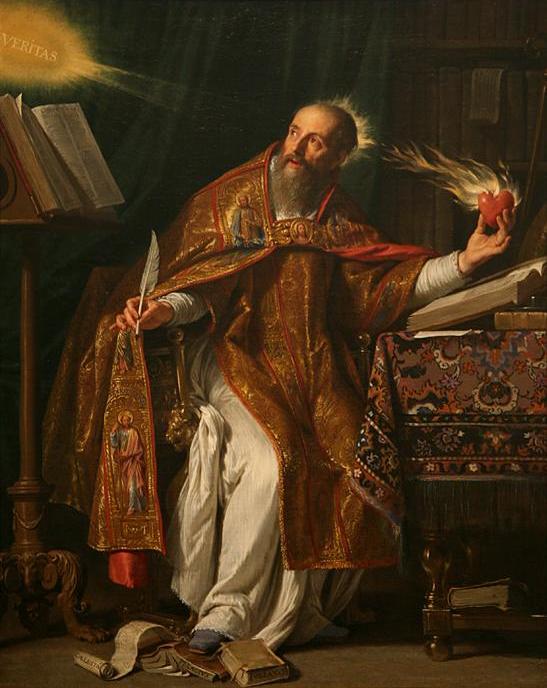
The essay is about The Saint Augustine Confessions, by (big Shocker) St. Augustine. It is a literary analysis of a passage.
In the late 300's AD, a famous, well-educated "heretic" named Augustine came to the city of Milan. A former teacher, Augustine was known as a dazzling rhetorician, and became an orator for the city, gradually moving up the imperial hierarchy. In this passage from his Confessions, Saint Augustine turns the literary artistry of his oratorical talents to the task of describing his disillusionment with Manicheism in the form of a prayer addressed directly to the Heavenly Father. His literary artistry is shown in his use of extended apostrophe and imagery to communicate his humbled submissiveness to God.
Augustine was born in 354 AD in the North African city of Thagaste. His father, Patrick, was a pagan, and his mother, Monica, was a devout Christian who labored untiringly for her son's conversion to Christianity. Augustine received his grammar-level education in Thagaste, and, with the blessing of the wealthy patron Romanianus, went on to study rhetoric in Carthage. It was in Carthage that Augustine took up the doctrine of Manicheism, a theological philosophy that claimed that all matter and darkness were evil, and all light and nonmatter were good. After spending years as a teacher in Carthage and Rome, in 384 Augustine traveled to Milan to become an orator for the city. It was in Milan that Augustine met Ambrose, the city's bishop, who welcomed Augustine like a father, and introduced him to the works of the theologian Origen. Augustine maintained his Manichean beliefs for the time being, and critiqued Ambrose's sermons with contempt for their subject, but with the objectivity that one craftsman uses in appraising the work of another, regardless of content. In this passage, which accounts for events occurring sometime between 384 and 386 AD, Augustine speaks of his wish to have further discussions with Ambrose, Bishop of Milan.
Reviews of: "The essay is about The Saint Augustine Confessions, by (big Shocker) St. Augustine. It is a literary analysis of a passage."
:
More Christianity
essays:
It represents approximately 1975. It is written from a Wesleyan Pentecostal perspective and attempts to demonstrate the importance of eschatology to the movement.
... a disillusionment with any part of the system. Systemic theology utilizes the basic categories of theology ... a future rather than a future speaking to the now. Of interest to this study is the manner in which Wilder comes to his conclusion ...
Analysis of The Parable of the Dishonest Steward. Asked to focus on the idea of a parable and analyze this specific parable in the New Testament.
... slave-manager was probably a syntrophas, he is also more educated than the other slaves because he probably attended primary school ...
It is about Passover and its traditional foods.
... place well before noon of the first seder. While other methods of destroying chametz are allowed, such as scattering it to the wind, or flushing it down the toilet, the most fun and certainly most educational one ...
Saint Augustine of Hippo's "The City of God"
... the City of God. Born in North Africa to a pagan father and a devout Catholic mother, a youthful Augustine lived a hedonistic life style following the controversial Manichaean religion. He went to Carthage to study rhetoric and ...
The Role and Function of the Holy Spirit in the book of Romans
... alienated from God have not simply been entered into the heavenly register of the redeemed; the Spirit indwells and empowers them to live ...
Who was Jesus - A Humanities Essay That Teaches The Study of The Bible As A Historical Document
... had of their Gods for centuries before). Matthew 12:49-50, Jesus announces to multitudes that they are his mother and brothers. In that way, he puts himself at an equal level to ... use of confession to priests by the Catholic followers (I felt that each indiv. should confess only ...
About the Crucification of Jesus and some of the major points of it and many other things
... thing. While Jesus was on the cross he saw his mother there weeping and told John to take care of her, this showed Jesus pride in what he did for ... were mocking him. The first words that he spoke were " Father, forgive them for they know not what they do." Even ...
The City of Ephesus in Biblical Times
... Ephesus? Well when glancing at the City of Ephesus ... name of the Lord Jesus was magnified.? ?And many that believed came, and confessed, and shewed their deeds.? ?Many of them ...
It was ok
this was an ok analysis. it could have gotten more into depth but it did cover the basiscs. overal i throughly enjoyed it please keep writing and posting
0 out of 0 people found this comment useful.