Euclid: The Math Wiz
Euclid, a Greek Mathematician, is one of the most significant and finest read mathematician of all time. His prize work, Elements, was the manual of basic geometry and logic up to the early twentieth century. For his work in the field, he is identified as the father of geometry and is thought to be one of greatest Greek mathematicians.
Very little is known about the life of Euclid. Both the dates and locations of his birth and death are unidentified. It is thought that he was taught at Plato's academy in Athens and dwelled there until Ptolemy I asked him to teach at his newly founded university in Alexandria. At this school, Euclid founded the school of mathematics and remained there for the remainder of his life. As a teacher, he was most likely one of the mentors or teachers of Archimedes. All accounts of Euclid describe him as a nice, reasonable, tolerant man who quickly assisted and honored the others works.
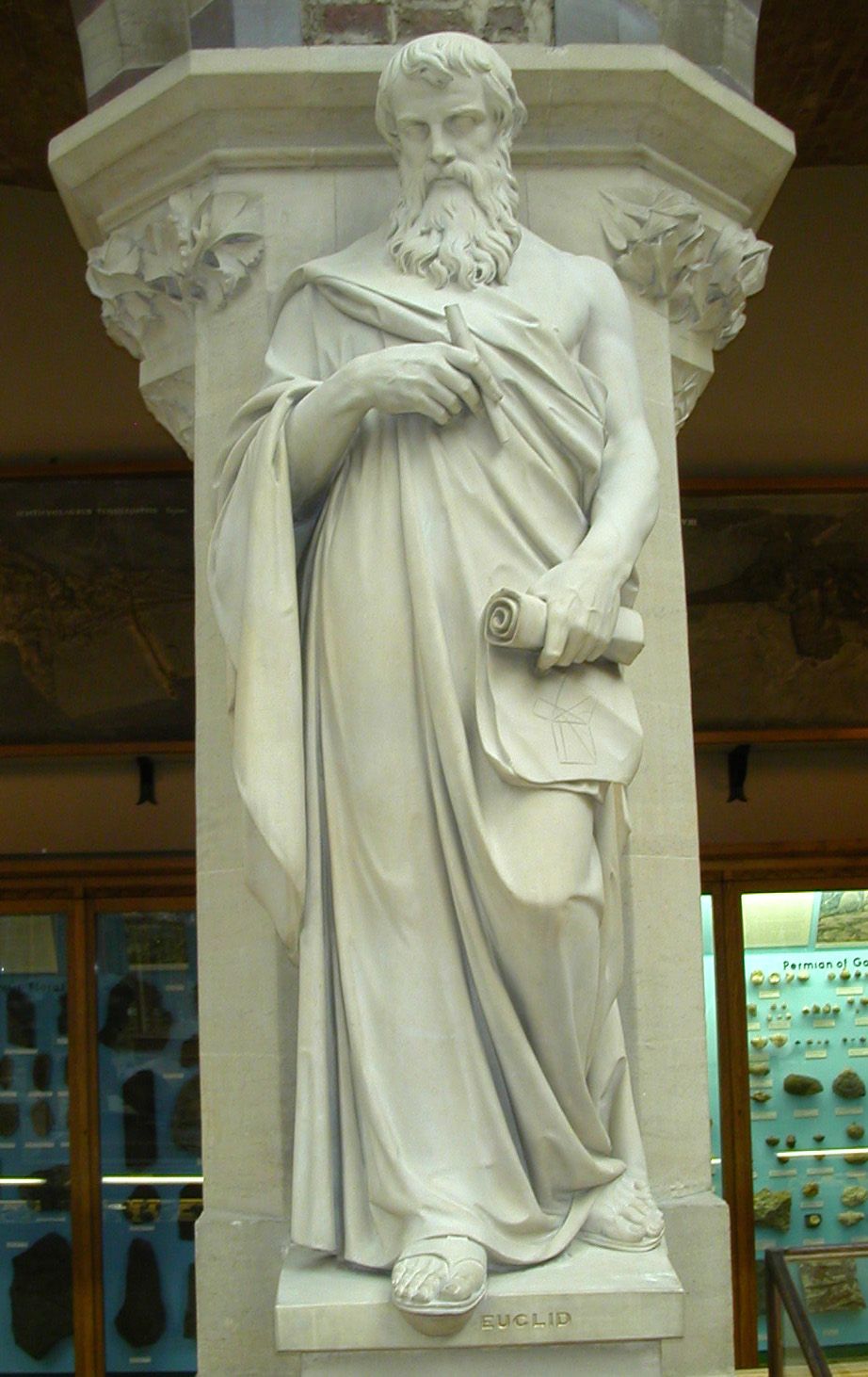
Euclid's reputation came from his works and writings, particularly his work of genius called, Elements. This 13 volume series is a compilation of books about Greek mathematics and geometry. It is not known how much, if any, of the work incorporated in Elements is Euclid's original work. But it is know that the format of Elements is Euclidâ ®s. Each volume lists a variety of definitions and hypothesizes ensued by theorems, which are followed then by proofs using those definitions and postulates. Each statement was proven, no matter how obvious. Euclid picked his postulates vigilantly, picking only the most basic and obvious propositions as the foundation of his work. Before, rival schools each had a different set of postulates, some of which were very debatable and naive. This format assists the standardization of Greek mathematics. As for the...
More History Term Papers
essays:
The comparison between Bradford and Domat's views on the role of God throughout history.
... for the suffering of others in peril. he believed that God punished them with disease, suffering and death. He writes as an example of a young man ... Domat does not believe that there is freewill, he's basically saying that everything is meant to be and there is no way to change it. If God wanted ...
Conflict and Violence as the major theme illuminating the history of the world in the twentieth century.
... millions of deaths - marked the beginning of the twentieth century, surely a baptism of fire. The causes of World War One are complex and interlinked. The ostensible and immediate ...
Eleanor Roosevelt a Great American that shaped America and left behind a legacy for others to follow.
... actions and writing affected twentieth century American politics, society and economy. Eleanor is know as one of the most influential women of the twentieth century. Her ...
this essay is over the events and studys of aristotles life there is a work sited page and work sited in the essay also
... Strolling") school. Upon the death of Alexander in 323 BC, strong anti-Macedonian feeling developed in Athens, and Aristotle retired to a family estate in Euboea. He died there the following year. Aristotle, like Plato, made ...
Euclid Of Alexandria
... the father of geometry." As legendary as his work is to the world, his personal like if just the opposite. There is very little known about his life. In fact, his birth and death places and dates ...
Did the actions in Corfu and Bulgaria add or take away from the League's reputation?
... severity of the situation. After a while, the Greeks did as the League said and left Bulgaria. And this was another war successfully avoided, thanks to the League. Their reputation certainly ...
Explain if the League's actions in Corfu and Bulgaria diminished or improved the League's reputation.
... oblige, and in that way was war averted. A similar instance is that of Greece and Bulgaria, where the Greek invasion of Bulgaria ...
The Irish contribution to the Dark Ages. Knowledge of Christianity, literature, and art, proved to be economic centers of Ireland.
... Palantine School, just after Charlemagne's death, in about 832AD (*). He was one of only two Westerners to be fluent in Greek at the time, and his work matched Plato's ...