Euthanasia
Euthanasia and assisted suicide are two of the most important public
policy issues debated today. These issues have raised the question: when does the motivation to help people suffering from pain go too far? With this in consideration, the outcome of this debate will greatly affect family relationships, interactions between doctors and patients, and basic concepts of morality. There are numerous groups that support euthanasia and also many that are against it. Some argue that a person should have the "right to die" is they so please, while others oppose this argument by saying that there are other options out there. Options that can alleviate the pain that is causing the will to die. When asking yourself if you agree with the legalization of euthanasia or not think about what a person's life is worth, not only to them, but also to their family and friends. Requests for euthanasia stem from pain and depression, and both of these problems can be treated; therefore arguments for legalizing euthanasia are unconvincing.
 Church of Euthanasia. About Death and Dying. About...
 English: Dr. Jack Kevorkian, best known for his ad...
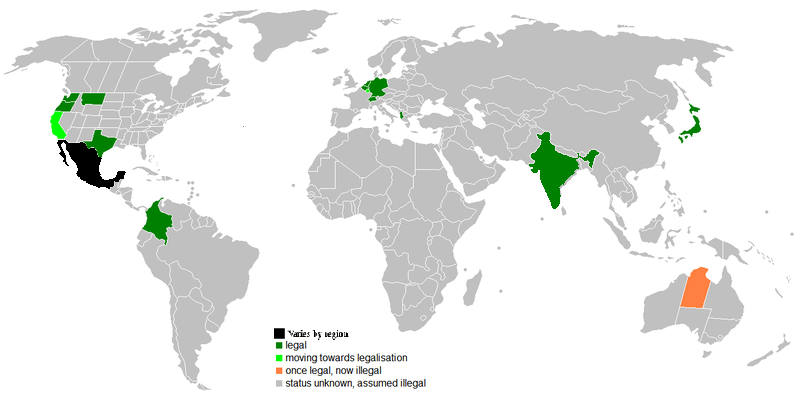 Legality of Euthanasia throughout the world
The definition of euthanasia is far too often confused with another term
called "assisted suicide". Many people fail to differentiate the two since their meanings are extremely similar, however they are not identical. With euthanasia, one person does something that directly kills another person. For example, if a doctor gave a patient a lethal injection that would be considered euthanasia. With assisted suicide, a non-suicidal person only provides the means or acts in some way to help a suicidal person kill him or herself. They do not directly kill the person with such requests to die. For example, a doctor who wrote a prescription for poison and gives it to a patient would be assisting a suicide. These two terms are extremely close in definition, but are not the same...