Euthanasia Exploratory
Mercy killing or euthanasia is the act by which a person suffering from a severe and painful illness, or injury, is released from life through a less painful and faster method. Strange though it may seem it has existed in early times as well: Soldiers through the centuries- as far back as the Greeks and the Romans-have killed wounded comrades rather than leave them to be captured alive by their enemies or to die on battle fields. The assumption being that the enemies will torture the wounded man or that he will die slowly and painfully. In fact there are stories where soldiers have made pacts with each other to be killed if they were wounded. In recent times, there has been a lot of publicity as more and more people are beginning to debate that mercy killing is a good thing. However even though the term "mercy killing" is used to describe the act of "allowing a person to die in dignity" there are a few different situations involved.
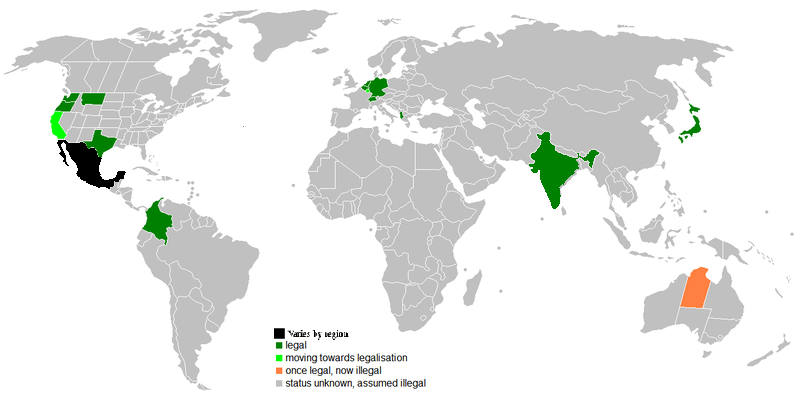 Legality of Euthanasia throughout the world
 Euthanasia machine invented by Dr. Philip Nitschke...
 English: The Kaschenists' poster.
Often when the subject is discussed, the example given is about someone suffering from a painful or terminal illness. However the truth is that several situations are encountered. In this light, it seems that though for some cases the argument is straightforward, it is not so for others. Each case needs to be analyzed separately. There are cases where a person is kept alive by mechanical means. All signs show that there is no hope of the person recovering because his brain is dead. Now, up to the present moment, it is widely acknowledged that a person is considered dead only when his heart stops beating. Hence, the debate is now on to see if a person who is brain dead can be considered dead as well. Here...