It is believed that Amenhotep III ruled for almost 40 years during the 18th Dynasty of Egypt's history that represented one of its most prosperous and stable periods. Modern historians later dubbed this period of history the "Golden Age". However, many argue that Amenhotep III came to power at a time when Egypt was at its highest point, that the pharaohs before him were responsible for its prosperity, and little needed to be done by Amenhotep III to maintain its high status. It is even suggested that he did more harm then good, as many believe he was the instigator behind the motives of Akhenaten, his son, who would later become responsible for throwing Egypt into chaos.
When Amenhotep III inherited the empire at the age of twelve, Egypt was in no great danger. Solid diplomatic policies established by his grandfather Amenhotep II, and his father Thutmose IV, along with the conquests of Thutmose III prior to them, had assured that Egypt was the richest country in the world, strong and secure politically, and exceptionally powerful.
 Cropped version of 34_louve.png which is part of a...
 English: Statue of Sobek and Amenhotep III, curren...
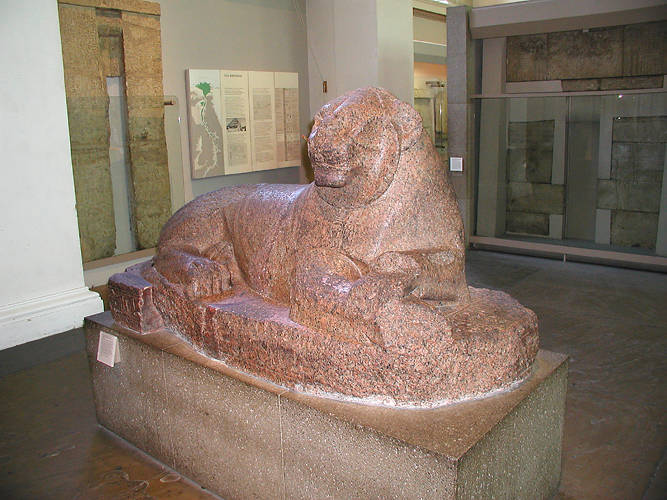 The Soleb Lion, time of Amenhotep III, 18th dynast...
Aside from a few small incidents Amenhotep III spared his people from war and conquering was not an issue. At the age of 16 he took part in the only major military campaign of his reign. He was victorious in defeating a Nubian rebellion, taking 30 000 prisoners and commemorating the victory on stelae. Although little military action was needed during his time, Amenhotep III still claimed to be a strong and powerful man capable of combat.
Amenhotep III was a great diplomatic, being largely advantaged by Egypt's wealth. He was widely respected internationally, having good trade links, marrying daughters' of foreign kings, and had a large gold supply. It is believed there was an increase in foreign trade during his reign.
His great royal wife Tiye seems to have been more powerful and important than any queen before her (barring the pharaoh Hatshepsut). Tiye was often depicted on the same scale as her husband, and appears to have been involved in politics. She also held religious importance, being associated with many different goddesses.
Amenhotep III is most remembered for his great building program, honoring the gods and goddesses on a scale much larger than anybody before him had attempted. One of his greatest achievements was the temple of Amun; it depicted Amenhotep's birth from the god.
It is these monuments, as Amenhotep liked statues of himself, which lead many historians to believe he was an arrogant and egotistical man. They claim he build endless structures and devoted much of his time to self-promotion.
Additionally, it was during Amenhotep III's reign that it's believed the first temple of Aten appeared. He begun focusing on solar religion, paving away the path his son would later choose to follow. It has even been argued that Akhenaten may have worshipped his father as Aten.
It is subject to controversy whether or not Amenhotep was as good a ruler as he was depicted as being during this "Golden Age". Some historians believe he was a noble man, while others claim he was conceited, worried more about himself than on the affairs of state. However, most agree that the reign of Amenhotep III marks the zenith of ancient Egyptian civilisation, both in terms of political power and cultural achievement. Whether or not he was directly responsible for this, or was just going along for the ride, remains undecided.