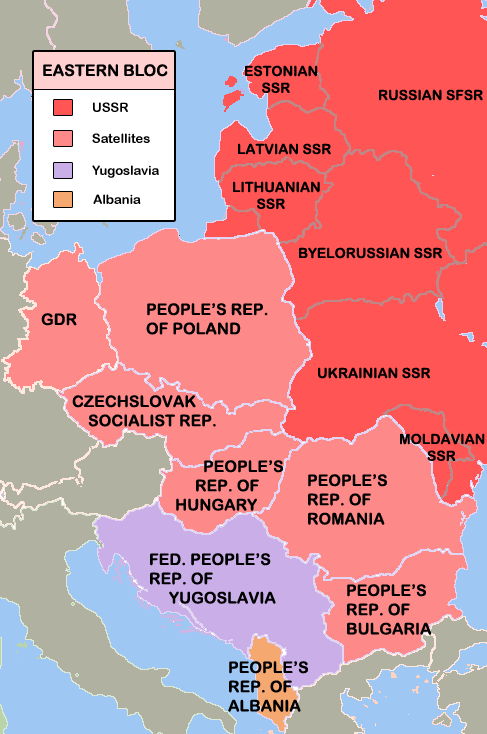
To What Extent was 'Sovietisation' imposed on Eastern Europe after 1945? Discuss with reference to at least two countries in the region - two countries referenced are Poland + Czechoslovakia
To What Extent was 'Sovietisation' imposed on Eastern Europe after 1945? Discuss with reference to at least two countries in the region
The dominant conflict following the end of the Second World War was the hostility and competition between the Soviet Union and the West, in particular the United States. For decades the origins of this conflict, the cold war, has provided a basis for an enormous and varied histography. Central to any argument put forward by a historian is the question of the communist seizure of power within Europe. By 1948 every country in Eastern Europe was run by communist parties, and with the exception of Yugoslavia, worked closely with the Soviet Union. This is often referred to as the 'Sovietisation' of Eastern Europe as most of these newly formed communist nations based themselves politically and economically on soviet based models. This has led to a popular histography mainly influenced western Historians to assert that 'Sovietisation' was in fact forced onto Eastern European nations by the Soviet Union (orthodox theory). They accused Stalin of attempting to create a system of satellite states in Eastern Europe, thus creating a communist empire . Throughout this essay I shall explore this argument that has been put forward by the western historians, though taking into account some of the revisionist perspectives, proving that Stalinism was imposed on Eastern Europe by referring mainly to Poland and Czechoslovakia.
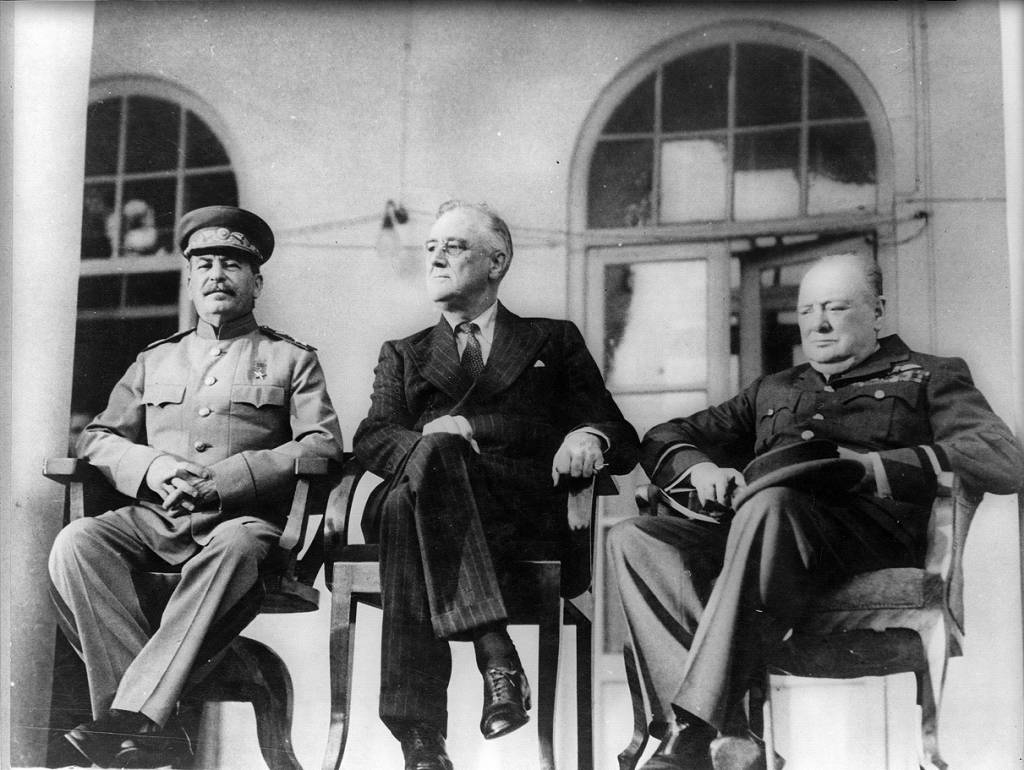
One of the major factors which was responsible for enhancing the influence the communists had throughout Eastern Europe after 1945 was the legacy of the Second World War, this is outlined by both historians of the orthodox and revisionist perspective. Eastern Europe had been acknowledged as the Red Army's responsibility in the Tehran talks of December 1943 and in October 1944 during the 'infamous percentage agreements' orthodox...
More World History
essays:
To what extent did soviet policy toward Nicaragua and Cuba during the 1980s confirm the U.S. image of an aggressive, interventionist global power intent on confronting the United States?
... anti-Communist objective of "fighting the cold war on all fronts," declarations from Washington such as those of Secretary of State Alexander Haig about "going to the ...
To what extent was Germany responsible for the Second World War?
... willing to use aggressive war-making to achieve his goals, which were the revision of the Versailles Treaty, Anschluss, the unification of all German-speaking peoples, and Lebensraum, the attainment of "living space" in Eastern Europe (including ...
To what extent did the Cultural Revolution in China affect the destruction and elimination of all religious institutions in Albania (1967-1970)?
... the communist nation"(X). This source is extremely important in its historical context particularly because it is Hoxha himself speaking to the party members ...
To What extent did the US escalate the Cold war?
... support conflicting communist states and sometimes even co-operate with their regimes. Since nationalism would prove more durable than communism, Keenan expected international communism to break up sooner or later. The third goal was to lead the Soviet Union away ...
To what extent was Germany weakened through loss of territory militarily and economically?
... Nations, mainly set terms for dealing with Germany. These included taking blame for initiating World War I, restrictions on military, loss of territory, and reparations. The losses of territory militarily would be a lesser extent than the losses on Germany economically ...
The Russian Revolution: To what extent was powerful revolutionary leadership and clear revolutionary ideas the reason for the successful Bolshevik revolution in October 1917?
... the communist party to gain control of all aspects of human life, therefore creating a totalitarian state. Trotskyism was also based on Marx's theory of a "permanent" revolution. Trotsky believed that national economic development ...
To what Extent was the League of Nations successful in the 1920s?
... through Europe by intervening the early stages of the problem in the Soviet Union. The Commission of Refugees resettled 400,000 prisoners of wars and wars that ...
To what extent has Arno Mayer (historian) understood the 'Holocaust'?
... in Eastern Europe, were contained within what we call the Second World War." However the anti-thesis of Mayer's historical understanding comes from the interpretations of Browning, Goldhagen and Friedlander. Browning provides the viewpoint of a non-Jewish historian. He ...