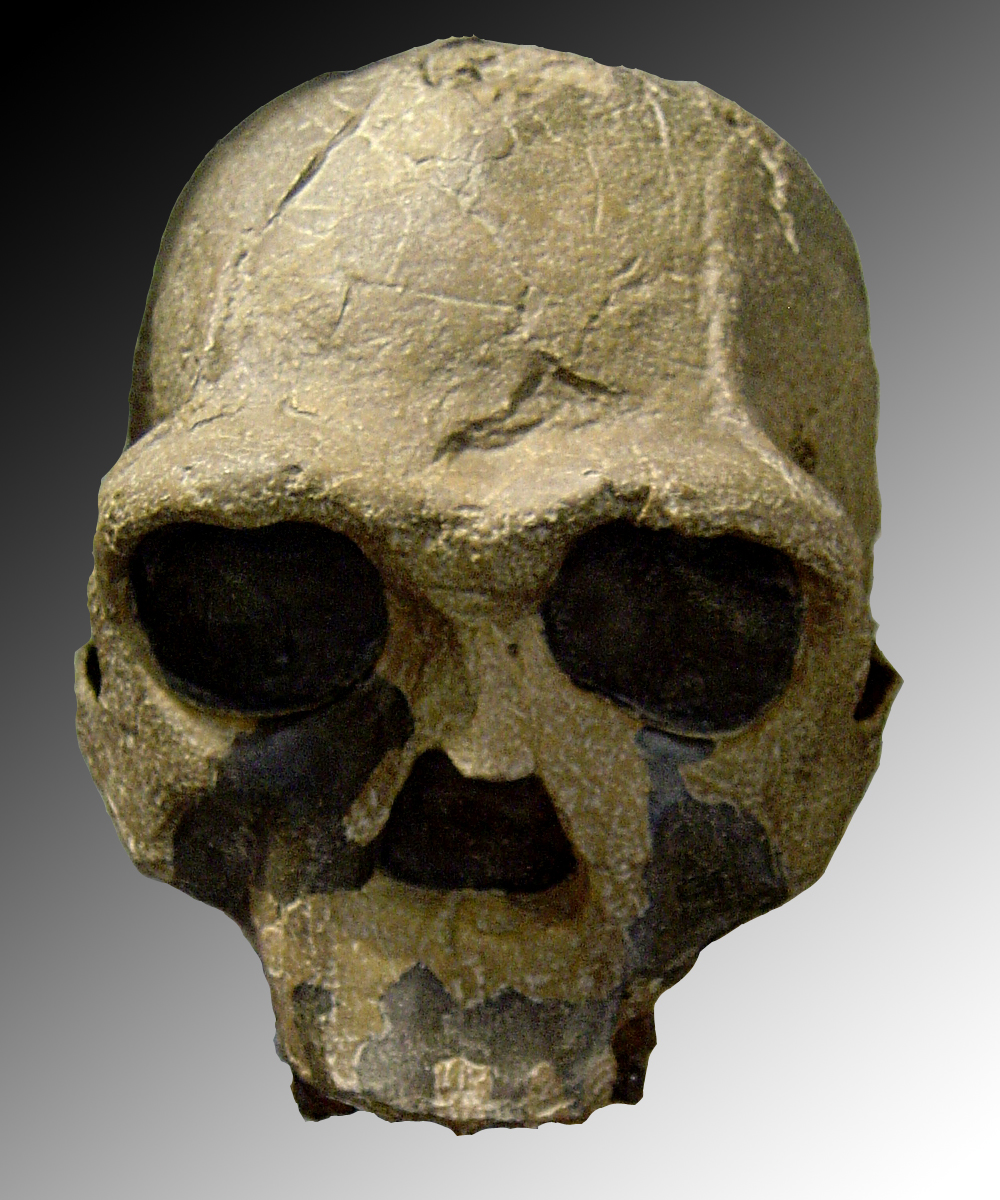
Homo Ergaster A Description of the Life of a Ancestor to the Lineage Now Known as Homo Sapien.
A new lineage of the genus Homo emerged in Africa around 1.9 million years ago known as Homo ergaster. Homo ergaster, which is translated as workman, is thought to be an early version of Homo erectus. Homo ergaster is a species name used to indicate the fossils of Homo erectus, Homo heidelbergensis, and Homo sapiens that lived in Africa during the Lower Pliocene. An almost completely intact Homo ergaster skeleton, called the Nariokotome boy, was discovered in August of 1984 by a scientific team led by Richard Leakey on the west bank of Lake Turkana, Kenya. Nariokotome boy gives us the best description of this species, because before its discovery, there were only two skulls that defined this entire species.
The Nariokotome boy, after analysis, was revealed to be an 11-12 year old boy that died from septicemia after the shedding of one of his milk teeth. In today's time, antibiotics would have protected us from such an infection; however Nariokotome boy perished falling face down in the marsh and was buried by swamp mud for 1.5 million years. Nariokotome boy is estimated to have been about 5 ft. 3 in. tall at death, which is unusual for an 11 year old and it is thought that he have reached 6 ft. 1 in. tall if he would have lived into adulthood. He was tall, muscular and had a sturdy skeleton. He was about 78 lbs. at death and would have probably reached 154 lbs. One of the most surprising things about the skeleton was how closely it resembled modern humans living in conditions similar to that of Nariokotome boy. The limb proportions are very much that of modern humans except for the shin bones, which are longer than ours and the lower limb long-bone joints suggest...
More Archaeology
essays:
Human Evolution: Discuss the significance of the recent discovery of homo floresiensis for paleoanthropology.
... dimensions of other hominid populations. This reiterates it's separate classification but does not necessarily preclude lesser intelligence. Also outlines that H.Floresiensis is the smallest known species in the genus homo. The species most ...
Transitions of Reptiles to Mammals
... number of advances over that of reptiles. the mode of ossification (process of bone formation) of the long bones is ... narrower, deeper, vertebral column more strongly constructed. Ilium further enlarged, lower-limb musculature starts to change. This animal was more mobile and ...
The James Ossuary and the Jehoash Tablet.
... ossuary is a chest that holds human skeletal remains, a bone box, and was a popular method of burial for Jews during the Roman Period from about First ... rich man. Fortunately, it seems Oded Golan tempted fate a few too many times, and now will be unable cause another forgery to surface at a certain ...
Chinese Views on Death and Dying Burial Techniques, Rituals and Beliefs of the Common Man
... different names for death are scattered throughout Chinese history, including an ideogram that depicts a person kneeling in front of their ancestor's bones 1 ...
Movement of a pre historic culture The Nebulosa Chain
... seal bone was found along with sea unchain shells. Echinus Bay Echinus Bay is located on Helios Island, which is aproimatly. 80km long and 50 km wide. The Island has a little lake in ...
Gondwanaland: A Study of the Continent in a Theoratic Sense.
... are absent from the northern continents. He named the ancient landmass Gondwanaland for a region in central India that displays the typical geological features of the Permian and Carboniferous periods. Gondwanaland A Long Time Ago... Gondwanaland, Present Day... And: The ...
Excavation is destruction." Explore with examples a range of justifications given for excavating sites.
... enthusiastic amateur archaeologists to excavate projects, often in their spare time (holidays and weekends). Although this form of excavation offers indisputable experience to students and volunteers, it has ...
THE MYSTERY OF THE CRYSTAL SKULLS
... does not alter with the passing of time. It weighs 5 kg (11 pounds, 7 ounces) and is life-size (13 cm high, 18 cm long and 13 cm wide ... were also discovered. MAX Max is a white crystal skull of rough cut. It has very simple sockets for eyes, teeth are simply defined. Overall it's a very simple design ...