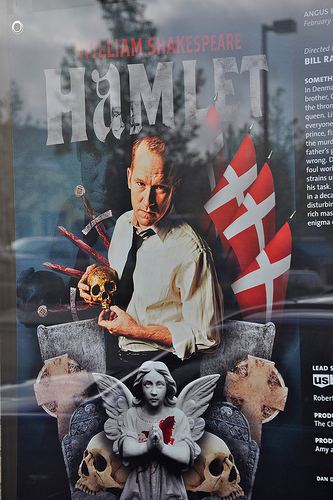
Illusion and reality in Hamlet.
A common theme in Shakespeare's plays is that of illusion and reality. It can be seen at work in a variety of ways in Hamlet.
The distinction between illusion and reality would appear to be obvious at first glance, but in fact, as Shakespeare illustrates, it often is not clear at all. What is perceived to be 'real', is often decided by the individual. The word 'real' also includes the idea of truth and, as can be seen in Hamlet, truth is frequently hard to see because a decision can only be made according to knowledge and experience.
The play opens with a night setting and the first discussion we hear is about a ghost between a few soldiers. Immediately we are drawn into the theme - did they really see a ghost?
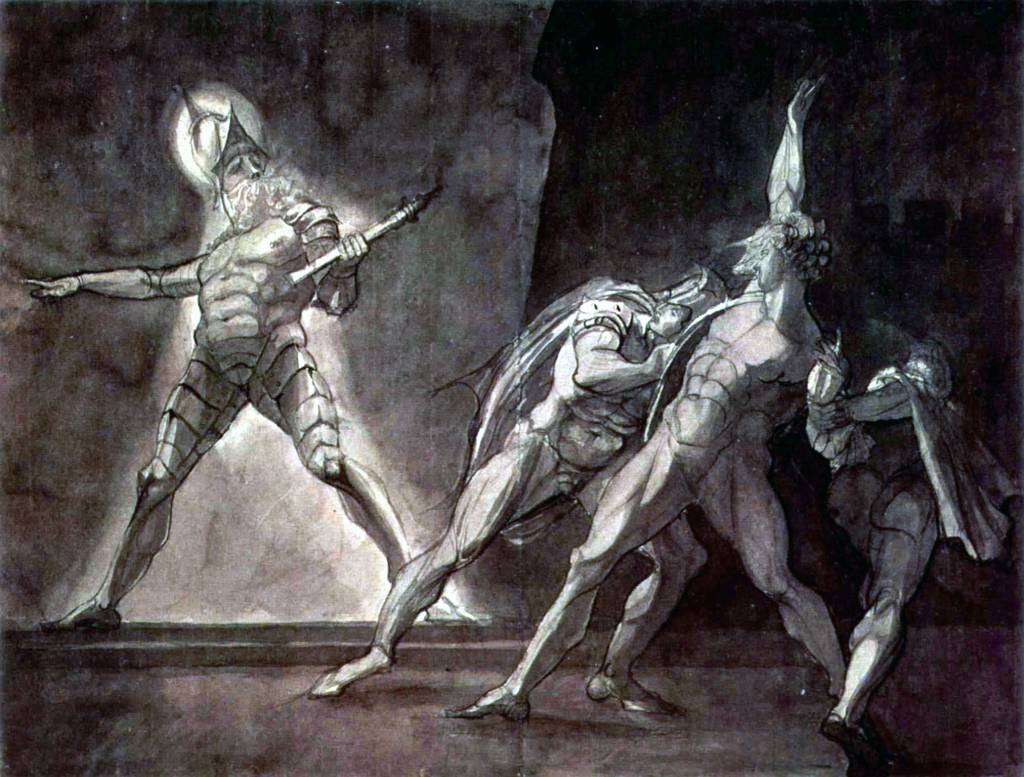
One way that Shakespeare explores illusion and reality is through the ghost. The ghost is deeply involved with the plot as he is the one that resurfaces events that were meant to never have been revealed, and also triggers Hamlet to avenge his father, which leads him into all kinds of trouble and consequently becomes the backbone of the play.
The ghost is Hamlet's father, and former king of Denmark. The ghost is used to create the mood of the play and makes the audience aware of something strange. In Act 1 Scene 4, to round off the mysterious events Marcellus quotes "There is something rotten in the state of Denmark". This is a very strong remark as it concludes that something is wrong, which works very well with the story as it indicates, although not directly, the eventual collapse of Denmark.
In Shakespearean times, ghosts were still considered a threat. Midnight was often known as the 'witching hour' where all the ghosts and monsters would come...
Reviews of: "Illusion and reality in Hamlet."
:
this paper was well written and is a good background for Shakespeare
Thnx. Really helped me understand what was really going on in the mind of Hamlet cause before I thought that Hamlet just kept overthinking everything.
More Hamlet
essays:
Role of Evil in Hamlet's Delay and Downfall. Hamlet by William Shakespeare. Discusses how Hamlet resists, falters and eventually succumbs to evil, heavily focuses on nature of ghost.
... does Hamlet have the ability to determine whether the ghost speaks the truth in the first place. To understand Shakespeare's ultimate intent in developing Hamlet's character, delay, and impending ...
Hamlet by Shakespeare deals with death and diseases. The essay "Death and Diseases in Hamlet" highlights how both are used as metaphors to deal with the actual theme of the play.
... deteriorating and being eaten by the worm. (The Use of Imagery in Hamlet) Disease is another imagery that Shakespeare uses in his play. In the first Act, ... comes to Denmark as the Ghost of Hamlet's dead father appears to Marcellus, Bernardo and to Horatio. "MAR: Look where it comes again./BER: In ...
Shakespeares Hamlet / questioning delay in revenge
... in reality, Hamlet was responsible. This is the first indication that Hamlet is a man of action. It is, revealed that Claudius was in no way responsible for the death of Laertes' father, and consequently ...
Hamlet, Divine Intervention and the Natural Order
... light: Shakespeare's Hamlet had yet another underlying meaning. Along with concepts of revenge, ambition, love, marriage, gender, class structure, morality, betrayal and deceit, appearances and reality and madness ...
Hamlet with lies and deception as characters decieve eachother for their own motives
... William Shakespeare's play, Hamlet, there are many characters in multiple situations which portray their intentions conversely. The characters Hamlet, Claudius, and the Ghost all ...
Hamlet Soliloquy Essay: This essay describes William Shakespeares Hamlet soliloquies.
... plight. Shakespeare utilizes soliloquies in order to show the audience the true feelings of Hamlet. His lengthy soliloquies put forth the raw emotions and thoughts of Hamlet, allowing ...
Hamlet was not insane. Learn about Hamlets destructive madness, and what he did.
... Claudius killed his father, he accidentally kills Polonius, and finally the ghost of his father visits him. These situations are enough to bring Hamlet to insanity, but he remains sharp and credible. Hamlet is able to make smart remarks to Rosencrantz ...
Hamlet
... King Hamlet In the play Hamlet by William Shakespeare, Hamlet's attitude toward the ghost changed with his new experiences throughout the play. His initial reaction was to agree with what the ghost had ... "The spirit that I have seen/ May be a [dev'l], and the [dev'l] hath the power/ T'assume a pleasing ...
WOW
Wonderful essay. The ultimate question is was the ghost a reality or an illusion? I loved your insight. Great job.
3 out of 4 people found this comment useful.