Karl Friedrich Gauss was born in 1777 and died in 1855. He was a German mathematician, physicist, and astronomer. Gauss was educated at the Caroline College, Brunswick, and the Univ. of Göttingen, his education and early research being financed by the Duke of Brunswick. Following the death of the duke in 1806, Gauss became director (1807) of the astronomical observatory at Göttingen, a post he held until his death. He was considered the greatest mathematician of his time and as the equal of Archimedes and Newton, Gauss showed his genius early and made many of his important discoveries before he was twenty.
Gauss was extremely careful and rigorous in all his work, insisting on a complete proof of any result before he would publish it. As a consequence, he made many discoveries that were not credited to him and had to be remade by others later; for example, he anticipated Bolyai and Lobachevsky in non-Euclidean geometry, Jacobi in the double periodicity of elliptic functions, Cauchy in the theory of functions of a complex variable, and Hamilton in quaternions.
 Oil painting of Carl Friedrich Gauss by G. Bierman...
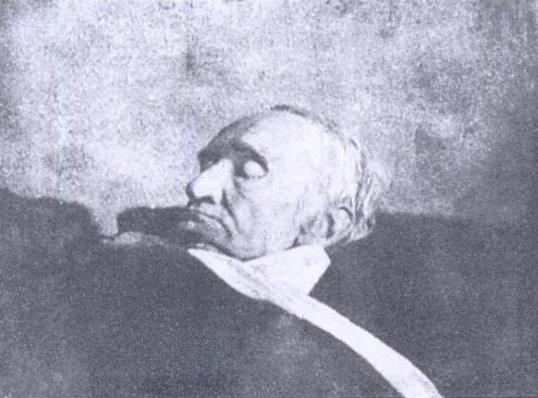 English: Carl Friedrich Gauss on his deathbad, 185...
 Statue of C. F. Gauss in Braunschweig
However, his published works were enough to establish his reputation as one of the greatest mathematicians of all time. Gauss early discovered the law of quadratic reciprocity and, independently of Legendre, the method of least squares. He showed that a regular polygon of n sides can be constructed using only compass and straight edge only if n is of the form 2p(2q+1)(2r+1)..., where 2q + 1, 2r + 1,...are prime numbers.
In 1801, following the discovery of the asteroid Ceres by Piazzi, Gauss calculated its orbit on the basis of very few accurate observations, and it was rediscovered the following year in the precise location he had predicted for it. He tested his method again successfully on the orbits of other asteroids discovered over the next few years and finally presented in his Theoria motus corporum celestium (1809) a complete treatment of the calculation of the orbits of planets and comets from observational data. From 1821, Gauss was engaged by the governments of Hanover and Denmark in connection with geodetic survey work. This led to his extensive investigations in the theory of space curves and surfaces and his important contributions to differential geometry as well as to such practical results as his invention of the heliotrope, a device used to measure distances by means of reflected sunlight.
Gauss was also interested in electric and magnetic phenomena and after about 1830 was involved in research in collaboration with Wilhelm Weber. In 1833 he invented the electric telegraph. He also made studies of terrestrial magnetism and electromagnetic theory. During the last years of his life Gauss was concerned with topics now falling under the general heading of topology, which had not yet been developed at that time, and he correctly predicted that this subject would become of great importance in mathematics.
Contributions:â¢At 24 years of age, he wrote a book called Disquisitines Arithmeticae, which is regarded today as one of the most influential books written in math.
â¢He also wrote the first modern book on number theory, and proved the law of quadratic reciprocity.
â¢In 1801, Gauss discovered and developed the method of least squares fitting, 10 years before Legendre, unfortunately, he didn't publish it.
â¢Gauss proved that every number is the sum of at most three triangular numbers and developed the algebra of congruences.
Famous Quote:'Ask her to wait a moment - I am almost done.'bibliographyinfo.comwikipediaboigraphy.com
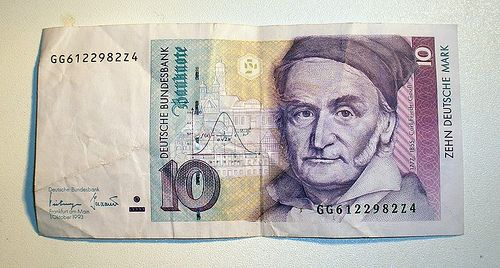 Zehn Mark I
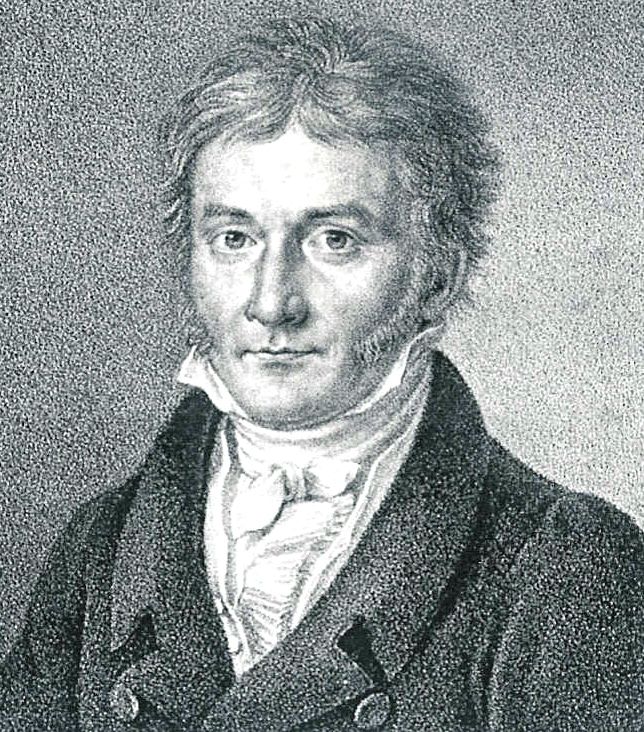 Lithograph showing a portrait of the German mathem...
 English: Therese Gauß (1816-1864), jüngste Tocht...