Like Water for Chocolate
Laura Esquivel
Like Water for Chocolate is a 3rd person, Mexican novel driven mostly by two topics, the disruption of tradition and how love conquerors all. The book also uses incredible imagery and figurative language to blend typical Mexican life in this time period with recipes and a little bit of magic. It is great for anyone reading at a high school level or higher.
At this time in Mexican society tradition was an extremely important part of everyday life. Tita, the main character, is in a constant inward struggle regarding whether to submit to the tradition she grew up with, which has been passed on for centuries, or to pursue her own desires. Basically the book forces the reader to contemplate whether to follow a tradition that defies what common sense and human nature tells us is worth maintaining the structure of an entire culture.
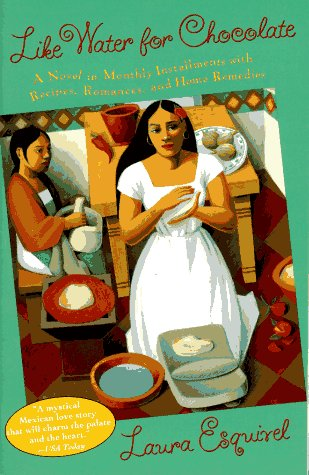 Like Water for Chocolate
 1978- Tita
 Pedro on Bridge 1
A tradition stating that the youngest daughter cannot marry and must remain solely to serve their mother until her death not only prevents Tita from marrying the man she loves, but also threatens to do the same to her beloved niece. Tradition threatens to tear the family apart as it causes Gertrudis, Tita's sister, to run away to escape the restrictions and Pedro, Tita's lover, to marry Tita's other sister, Rosaura, causing Tita and Rosaura to become enemies. It makes the reader think, is the upholding of family tradition worth the destructions of a family?
Another prominent theme in Like Water for Chocolate is the strength and endurance of true love. Throughout the book Tita and Pedro are forced to bear constant trials and terrible odds to remain together. After Pedro marries Rosaura, which he does solely to remain close to Tita, he and Tita are forced to hide their affection for one another, because to risk discovery would be disastrous. Tita is faced with a choice between moving on to avoid getting hurt or holding on to a seemingly impossible relationship. In the end Pedro and Tita end up together proving the ancient saying, "Love conquers all."
I firmly believe that what makes this such a great literary work is its use of figurative language and imagery. Esquivel's diction practically transports you into the story with its detailed descriptions and original comparisons. The way she easily transitions from recipes to narration gives her a unique characteristic that separates her from other authors.
This is a very romantic book. I believe it is more geared towards an adult audience due to some of the romantic descriptions. It is also most likely to appeal to those who are or have at least a slight interest in the hispanic culture, quite obviously because of the setting and description of tradition and everyday life.
Most of all, I believe it would appeal to and culinarian who is also an avid reader. It provides a chance to test out Hispanic cooking and traditional recipes while allowing one to divulge themselves in reading as well. In the book, Tita has a special relationship with the food she cooks, specifically that she can, subconsciously, put her emotions into the food she eats. Examples of this include Pedro and Rosaura's wedding. The saddened Tita is forced to prepare food. She does, but it turns out her misery and longing somehow got in the food. The wedding is a disaster because everyone is either feeling great longing or they're vomiting. On the opposite end of the scale, when Tita receives roses from Pedro she is forced to get rid of them by Mama Elena and makes a sauce out of them. When this sauce is used for the meal it has a strange effect on Gertrudis which eventually leads to her rebellion, escape, and being disowned from the ranch.
Basically this book is a great work of literature that should be on every high school reading list. Not only is if full of culture, exciting themes, and good lessons, but also should fill all the language and vocabulary needs for a growing mind.