Marbury v. Madison
5 U.S. 137 (S.Ct. 1803)
Facts: President Adams appointed William Marbury to the position of justice of the peace in 1801. However, Marbury failed to receive his commission before the end of the Adams Administration. The new Jefferson administration had ordered the secretary of state (James Madison) not to deliver Marbury's commission. By the Judiciary Act of 1789, Marbury sued Madison in the Supreme Court seeking a writ of mandamus forcing Madison to deliver Marbury's commission.
Issues: 1) Whether Marbury has a right to his commission.
2) Whether the law supplies a way to realize this right.
3) Whether the Supreme Court can lawfully issue a writ of mandamus to Madison.
Holding: 1) Yes
2) Yes
3) No
Reasoning: (Marshal , 6-0 court)
1) Marbury does have legal right to his commission because it was issued by the President and sealed by the Secretary of State.
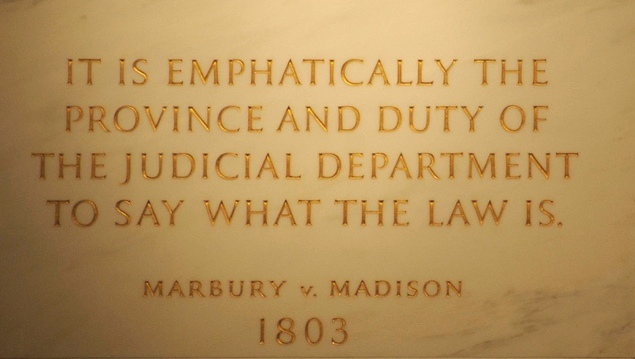 First Floor at the Statute of John Marshall, quota...
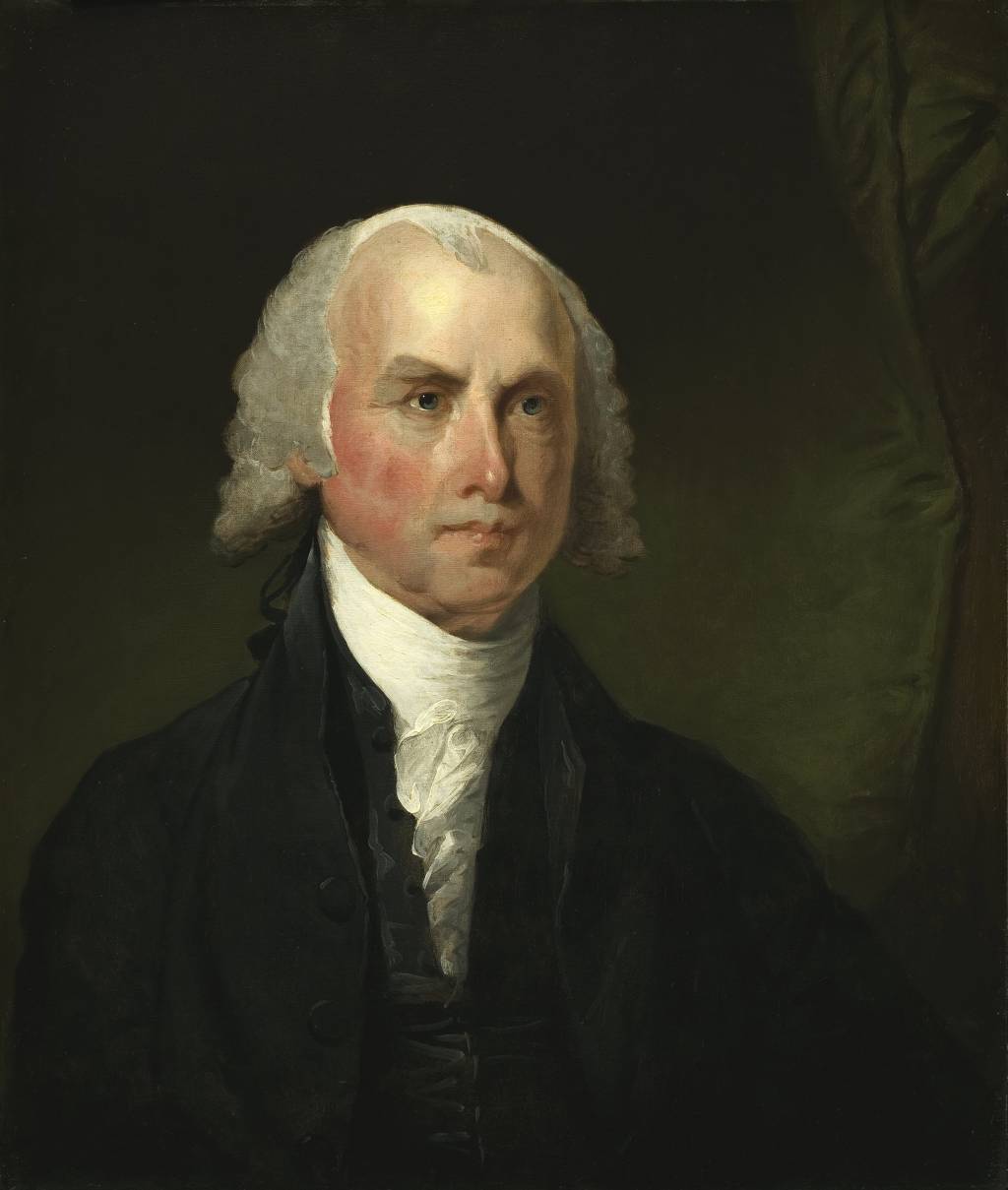 Secretary of State James Madison, who won Marbury ...
 Inscription on the wall of the Supreme Court Build...
This is confirmed by the act of 1801 when Marbury's position in office was created and confirmed by the senate.
2) Once Marbury was appointed to office, the position was signed and sealed, thus completing the appointment process. Denial of commission then becomes a violation of the law. It is not in the President's discretionary power to deny this commission. Thus, a remedy may be realized in the form of a writ of mandamus.
3) Issuing a writ of mandamus would be in conflict with original and appellate jurisdiction. The writ of mandamus demands an original action by a court of law, forcing an officer of the government to perform some specific duty. However, Article III section 2 of the Constitution limits the Supreme Court's jurisdiction to cases concerning "foreign ambassadors, other public ministers, and consuls", and to cases in which the state is a party. Neither Marbary nor Madison are a party to any of those categories.
Significance: This case is significant because it is the first example of the Supreme Court exercising judicial review to deem a provision of federal law as being invalid. This decision set into place the doctrine of judicial review. This gives the Supreme Court the authority to declare statutes unconstitutional. Thus, legislature can not pass laws contradictory to the constitution. Because it is the Supreme Court's role to interpret laws and resolve conflicts between them, the Supreme Court must have the power to interpret the Constitution and decide if a law passed conflicts with it. Marshall exercised a great deal of constitutional logic when exercising the judicial review.
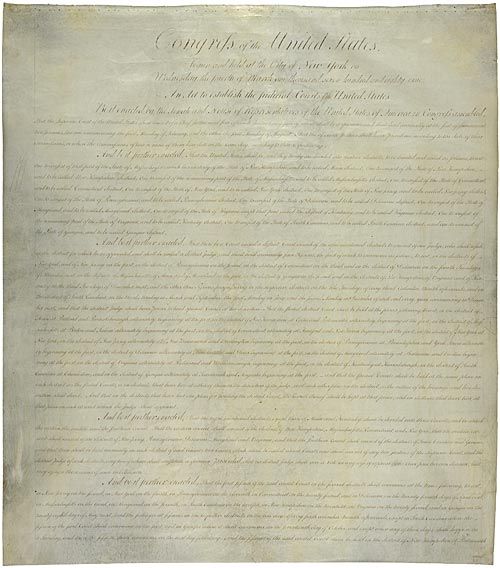 The first page of the Judiciary Act of 1789.
 First Floor at the Statute of John Marshall in the...
 William Marbury