The Mexican-American War was based on the Americans trying to expand their territory. They thought that some parts of Mexico was a good idea so they tried to buy the lands from Mexico, using an excuse that they want payback from the Mexico's owe to America during the Spanish War. The Mexicans refused, and when they surprisingly attacked a small American station, President James K. Polk of the United States wrote a letter to the Congress to declare war on Mexico. Thus the war starts, 1846. The Americans outflanked the Mexicans in most of the battles, and when the Americans occupied Mexico City, the capital of Mexico, the Mexicans decided that if they don't agree to America's demands, they might lose even more territory. And so they peace treaty was signed at the village of Guadalupe Hidalgo, near Mexico City. As a result, the United States acquired the region we now call the Mexican Cession.
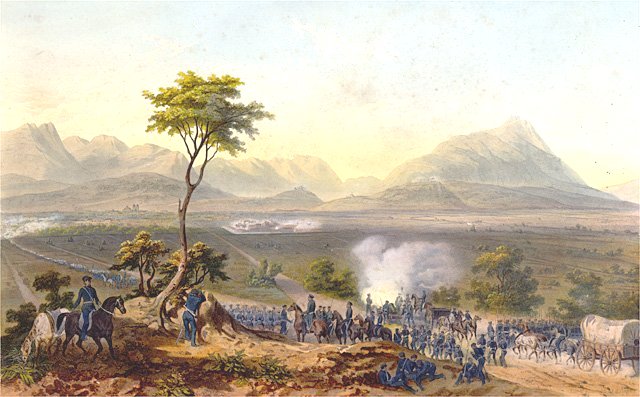 US troops marching on Monterrey during the Mexican...
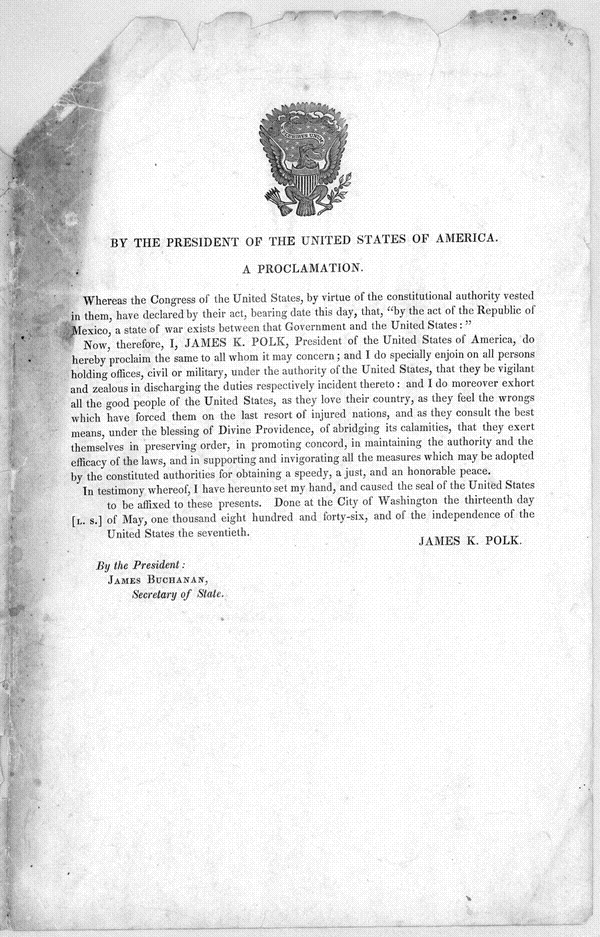 By the President of the United States of America. ...
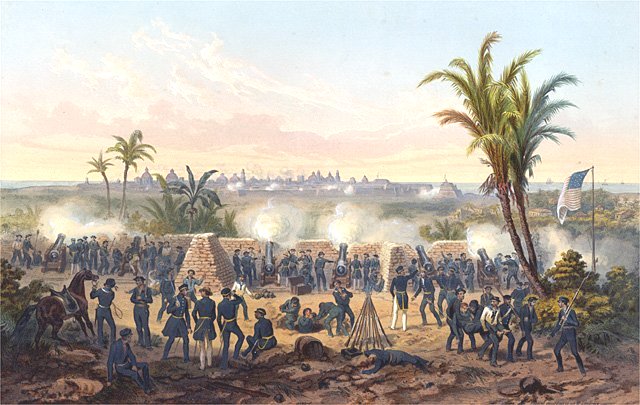 English: Battle of Veracruz during the Mexican-Ame...
During the Mexican-American War, the American army was divided into two, the US Army and the militia, which is composed of militiamen. The US Army was the American's national army, while the militia is an army of several states. They had a total army of 116,119 men and a navy of 12,319 men (1846-1848). During the war, they were better equipped and better led, which gave them a big advantage. When the war ended, the total losses were 13,283 men dead and 4,152 men wounded.
Zachary Taylor was a general in the US Army. He led his troops through various victories, including the occupations of Matamoras, Monterrey, Saltville and Victoria, and he also defeated the Mexican troops of Mexico City when the US armies almost lost there. Later he was elected president in 1848.
Alexander W. Doniphan, a colonel, led 850 troops through...
Impressed Again
You obviously are into history, and your writing is impressive for the 8th grade. Keep up the informative work.
4 out of 4 people found this comment useful.