Noble Gases
The Noble Gases are the far right elements on the periodic table. On the earth they are scarce so we don¹t see much of them. They are do not react well with anything. In fact until around the 50¹s they hadn¹t found anything that they would react with any of the gases. But then someone found out that Fluorine one the of most reactive elements could form compounds with Xenon. Later they found that it could react with most of the other nobles.
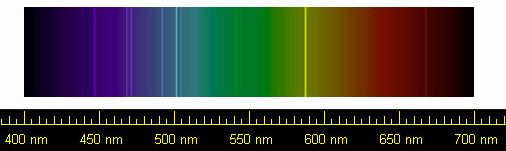
Helium is one of the more scarce nobles on earth but in the universe it makes up 25% of it. Helium¹s presence was discovered by using spectral analysis to detect helium in the sun¹s spectrum. Helium is not found a lot on the earth because gravity cannot keep helium from escaping to space. Helium is found mostly in stars, where it goes through nuclear fusion with hydrogen. Most Helium comes from natural gas taps in North America. It is used in balloons and divers use it with oxygen to breath easier and to not get sick or dizzy.
Neon is an element that is lighter than air. The element is found most common in the atmosphere of the earth. It is also found in the earth¹s crust. It was discovered in 1898 by Sir Walter Ramsey and Morris W. Travers. Its uses include electric signs,lamps,and lasers.
Argon is the most abundant and most used noble on earth. It was discovered by Lord Rayleigh and by Sir Walter Ramsey in 1894. Argon makes up about 1.2 % of the earths atmosphere. It is found naturally in rock and in the air. It is used for electric light bulbs and floursent tubes. It is also used a lot in industry.
Krypton a very rare...
Reviews of: "Noble Gases"
:
More Chemistry
essays:
Talks about the creation of the periodic table and some of its elements
... mercury is that iron floats in it, but gold sinks. The elements from the periodic table are in our everyday lives and have been with us ... that the air is not an element because he found many other elements within air. For instance, the air we breathe contains noble gases. The element, "W ...
How the Periodic Table of the Elements Works. Includes arrangement, history, applications and more.
... of the periodic table is the ability to predict what properties (eg: reactivity, conductivity) an element has by looking at its location on the table. For example, an element in ... electrons. The elements that have a full outer shell are the noble gases. Now that we know the basics of elements and ...
Chemistry Study Notes - The Periodic Table and What Its Classification of Elements Tells Us
... have the same number of valence electrons-the energy level of an elements valence electrons indicates the period on the periodic table in ...
The periodic table
... of elements called the noble gases were discovered between 1895 and 1901, an important change to the periodic table was made as these new elements were then added on a ... ) Uses of the element: without oxygen, there would be no life on this earth because oxygen is one of the necessities for life on this ...
A Brief History of the Periodic Table
... posted on their walls; a poster of the periodic table. The periodic table is simply a chart of all known elements, arranging them as defined by periodic law; it orders the elements by ...
The Comparative Abundance Of The Elements
... Sulfur 0.05% Barium 0.04%, Nitrogen 0.03% and the rest of the elements on the periodic table take up about 0.5%. The elements of the crust are ... thin layer of gases, 95% of these gases are within the first 20km of the earth's surface. Of the 17 elements that make up 99.5%, the most abundant ...
The History of the Periodic Table
... transuranic elements. He reconfigured the periodic table by placing the actinide series below the anthanide series. He also won the noble prize in chemistry. The element "106 ...
The Periodic Table of Elements
... of atomic structure it became apparent that Mendeleev had listed the elements in order of increasing atomic number. The main value of the periodic table is the ability to predict the chemical properties of an element based on its position in ... forms of chemical behavior. Earlier attempts to list the elements had usually put them in order of atomic mass. Mendeleev's key insight in devising the periodic table was to lay out the elements to illustrate recurring chemical properties and to ...
Detail
I think this can use some more detail. Your sentence structure also seems kind of repetitive. Next time maybe you can try using more variety in your sentence structure?
0 out of 0 people found this comment useful.