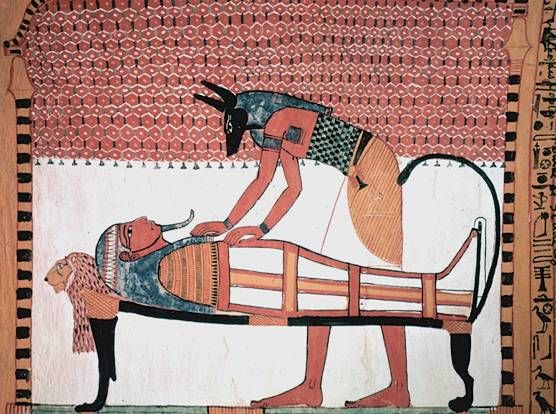
The process of Ancient Egyptian Mummification.
The Egyptian process of embalming, or mummification, is very interesting. Using special processes, the Egyptians would drain the moisture from the dead body, leaving a dried out carcass that would not easily decay. In the Egyptian religion, it was important to keep the body as life-like as possible. So successful were they that you can look at the body of a 3000-year-old mummy and have a good idea of what they looked like. This is what you will learn, and more, in the rest of my report. Enjoy!
Mummification was practiced throughout Egyptian history. The earliest mummies from prehistoric times were probably accidental. By chance, the sand and dry air preserved some bodies in shallow pits dug into the sand. About 2600 B.C.E., during the fourth and fifth dynasties, Egyptians began to mummify intentionally. The practice continued and developed for well over 2000 years, into the Roman period. Within any one period the mummification varied, depending on the price paid for it. The best-preserved mummies are the eighteenth through the twentieth dynasties of the New Kingdom, and include those of Tutankhamen and other well-know pharaohs. The history of mummification is interesting, huh?
The mummification process took at least seventy days. Special priests worked as embalmers, treating and wrapping the body. Besides knowing the correct rituals and prayers to be performed at various stages of the mummification process, the priests also needed a detailed knowledge of human anatomy. The first step in the mummification process was the removal of all internal parts that might decay rapidly. The brain was removed by carefully inserting special hooked instruments up the nostrils to pull out bits of brain tissue. It was a delicate operation, one that could easily ruin the face, a terrible thing in the Egyptian afterlife. The embalmers then removed the organs...
More Ancient Egypt
essays:
EGYPTIAN CIVILIZATION
... royal mummies is shedding new light on the genealogy of the pharaohs. The ongoing deciphering of hieroglyphic writings and research on the life of the peasants are also answering many questions related to the evolution of Egyptian culture. The pharaonic religion ...
The creation of the Ancient Egyptian Calendar and twenty four hour time had a significant impact on modern societies.
... Ramesside period describes what happened in the 13th century BC. "Winter is come in Summer, the months are reversed, the hours in confusion". This tells us that that over time the Egyptian calendar ...
Ancient Egypt
... They embalmed their dead and wrapped the bodies in layers of cloth. Preserved bodies were called mummies. The Egyptians caved ... geometry and surgery. The boundaries of ancient Egypt changed many times during its history. When the Kingdom of Egypt was formed in about 3100 ...
EGYPT--Description of Egyption culture, mummification, government and religion of ancient egypt--also a comparison with modern Egypt
... their dead. The Egyptians developed mummification for preserving their dead. At least nine steps were involved in the making of a mummy. It ... was a king who ruled as pharaoh in the 18th dynasty. He broke the traditional religion and preferred the god, Aten a sun god. He changed ...
Egyptian Burial Practices
... their dead in lavish tombs, but rather in small pits in the desert sands. The dryness and heat of the desert would naturally preserve the bodies. This process was used before mummification was set into practice. As time progressed, Egyptians began ...
Were the Egyptians preoccupied with death?
... a mummy's tomb meant that person's spirit may not survive in the afterlife supports the idea that the ancient Egyptians might have been preoccupied with the afterlife. The ancient Egyptians were not preoccupied with death in religion. The ...
Assess the impact of Akhenaten's reign on religion and art.
... from Egyptian history. It is also evident that when succeeding rulers deferred back to the traditional ways of religion and ... the time. Thus, for the period of Akhenaten's reign, his changes and reforms to art and religion dramatically ...
Ancient Egyptian Music.
... cultural history. Hieroglyphics and texts from Egyptian mythology show that music played a very important role in ancient Egyptian society ... in ancient Greece. The Lute -- A stringed instrument having a body shaped like a pear sliced lengthwise and a neck with ...