Title: The Incas: Civilization of the New World Desc: A formal report about many aspects of the Incan culture. Such as: diet, architecture, government, and religion.
The Inca Empire was a very strong presence in new world, the South Americas. They had amazing architecture, which was so good that it could hold a 40 foot stone wall together with out mortar. Their empire had over six million people in it, who were very law abiding people, and their strong government was also able to govern the people over vast distances, with many natural obstacles. The Inca diet mainly consisted of stew, maize, beans, and vegetables. And out of many other unique qualities, their religion was polytheistic, yet still had a human god.
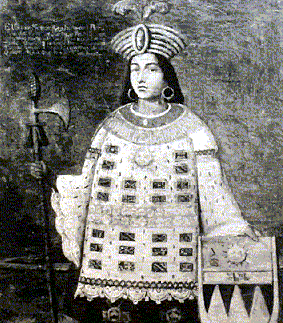
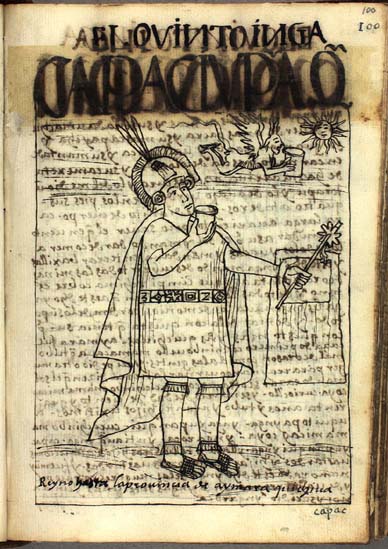
The Inca started out as a really small civilization. Their first ruler was Manco Capac. We don't really know much about him, although he called himself the son of the sun. When he was alive the Inca were still a very small tribe. All the tribes in the area were constantly making alliances to survive, but these only lasted a short time due to uncertainty of who was most powerful. Manco Capac lived around the year 1200. During his reign the Inca tribe did very little expansion. Many years later, when Yupanqui was the Sapa Inca, was when the civilization started to expand. This was in c. 1438. This was where it all started.
Out of all of the Inca's accomplishments, their architecture was one of their strongest. They constructed the huge city of Cuzco, their capital. Cuzco has the most surviving architecture of any Inca site. They were so good at building walls that they did not any mortar. Their walls stayed together so well that when an earthquake hit in 1950, 90% of the buildings were not damaged. Most Inca structures were build for form, not function, yet when it came to fountains, the Inca engineers let in a little beauty. Streams...
More Central & Southamerican History
essays:
Short essay on the level of sophistication of the Incas, Mayas, and Aztecs C.E 900-1450.
... 04 Short essay on the Mayan, Aztecs, and Inca C.E 900-1450 The civilizations of the Mayans, Aztecs, and Inca were sophisticated compared to the other civilizations in ...
The Maya Culture
... 7). The Maya culture had interesting aspects in their civilization or that they accomplished over time. The important aspects of the Mayas ...
History/Facts of Machu Pichu in Peru.
... by the disease by 1527. The government began to fail, part of the empire seceded and it fell into civil war. So by the time Pizarro, the Inca's ...
The Influence of an Incan Empire
... Inca way. In Inka mythology, Manco Capac along with his sister Mama 0cllo, also known as the "children of the Sun", emerged from the depths of Lake Titicaca to found their Incan empire. They then proceeded to take over many tribes ...
The Incas.
... In the 15century, led by Pachacuti Inca Yupaqui and his son Topa Inca, the Inca Empire exploded over the Andes. Both leaders claimed to be descendents of the sun, the most important symbol in Inca religious ...
Building An Empire (aztecs)
... more civilized tribes. At the same time that the Aztec warriors population increased so did the Aztec reputation for their military skills. In the year 1428, many of the Aztecs formed something called an alliance, also ...
The Aztec Calendar
... a time of great celebration as the culture had been allowed another cycle of life by the gods. Technology and civilization have an important relationship in the Stone Calendar of the Aztecs. The elaborately ...
The Aztecs
... at the time cannibalism was a delicacy amongst the Aztecs. Only the Aztec royalty were allowed to take on cannibalism. The hands and thighs were the Aztecs favorite parts of the body to eat. The Aztecs had a single ruler ...