Women and Alcohol
In this assignment I had been given the task to choose a client group and a drug, or group of drugs, which may be misused by that group. Then review the available evidence relating to prevalence and critically analyse the treatment options available along with their theoretical underpinnings, and finally debate the issues from a harm reduction standpoint. Thus, I have chosen 'Women' as my client group and 'Alcohol' as the drug which may be misused by that group.
So, broadly speaking, what is 'alcohol abuse'? And what is 'alcoholism'? There is a slight difference between the two terminologies. A fairly recent publication provided by Athealth.com, a leading provider of mental health information, defines 'alcohol abuse' as 'a pattern of drinking in which a person uses alcohol in a way that is harmful to themselves or others.'
Alcoholism or alcohol dependence is more seen as a disease.
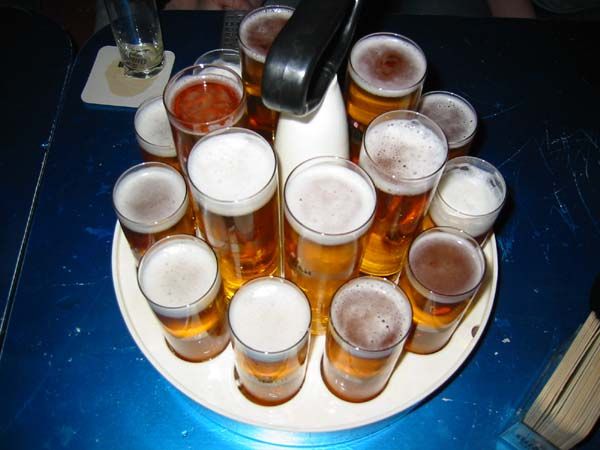 A Kranz (wreath) of Kölsch beer.
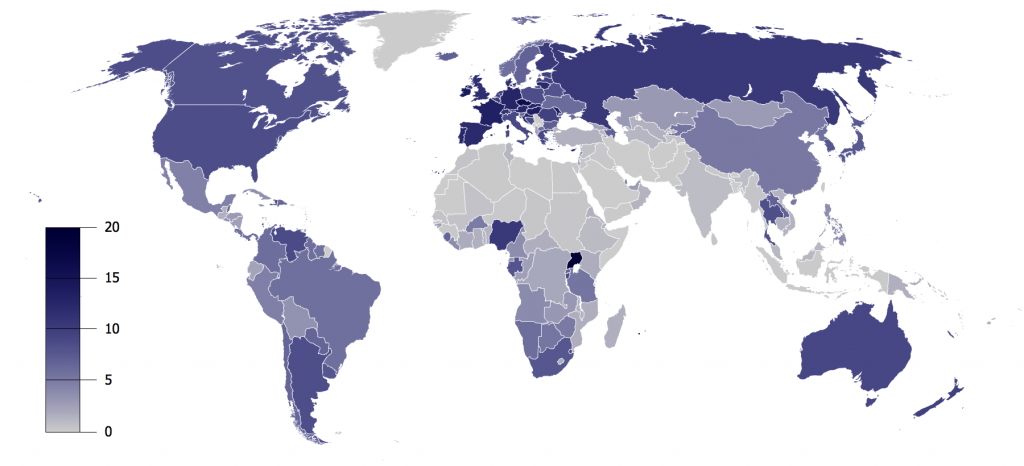 English: Total recorded alcohol per capita consump...
 7338 - Moscow - Bolotnaya Proshad - Children are t...
The World Health Organisation's definition of 'Alcoholism' (1952) read in part:
'Alcoholics are those excessive drinkers where dependence on alcohol has attained such a degree that it shows a noticeable mental disturbance or an interference with their bodily and mental health.'
Similarly, Keller's definition (1960) in Faugier and Kennedy (1989 p.56) also refers to the disease model:
'Alcoholism is a chronic disease manifested by repeated implicative drinking so as to cause injury to the drinker's health or to his social or economic functioning.'
The weaknesses of such definitions are that they avoid the exact explanation of the word and concentrate on the effects of the condition. The most common features of alcoholism are described by Gossop (2000 p.78) as: (i) an increased physiological tolerance to alcohol; (ii) withdrawal symptoms and craving when alcohol is not available (iii) inability to drink moderately.
It is generally agreed that in our society there...
Comment
Excellent paper, full of information and easy to read and understand. Great references.
1 out of 1 people found this comment useful.