Australian TCF Industry Tariff Redutions.
The Textiles, Clothing and Footwear industry is one of Australia's main manufacturing sectors, providing employment to over 87 000 Australians and accounting for more than 4% of total manufacturing. The TCF industry is a significant employer of Australians in both cities and regional locations and a main exporter. The industry is comprised of every stage in the marketing process from processing raw materials to retailing intermediate and finished goods.
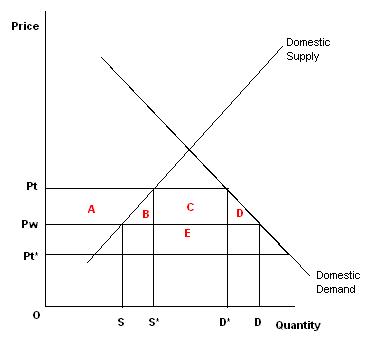
A distinguishing feature of the Textiles, Clothing and Footwear Industry has been the high levels of quota and tariff protection applied by many countries. The Australian TCF industry is no exception to this rule, enjoying high levels of protection with tariffs running as high as 30%. Tariffs are taxes imposed by the government to provide protection against foreign imports that can offer the same products for a cheaper price. To evaluate the impact of reduced tariffs it is important to understand that tariffs affect the economy in a number of ways. Firstly as tariffs increase the prices of foreign-produced protected goods they therefore encourage the goods production domestically, leading to the inefficient utilisation of capital, labour and other resources to produce a lower quantity of outputs. Tariffs also reduce the real income of consumers. Because tariffs increase prices paid for goods by consumers, the same good is purchased at a higher price. This means that Australia's total income is lower that it would be if there were no tariffs even though the companies directly involved in the TCF manufacturing industry may be better off.
In the first eight months of the 2003 financial year, Austrade brought $17.5 million worth of exports to the economy by providing market assistance to 23 TCF companies. Also, productivity in this industry was in no doubt as exports had been growing by approximately 14% per year,
Reviews of: "Australian TCF Industry Tariff Redutions."
:
A great read ellyjean! Very good research tool for anyone, I don't know much about the Australian TCF,...but this seemed very indepth. Well-done.
More Foreign & International Economics
essays:
Case Study on the Economy of Poland [2008]
... semi-processed manufactured goods and raw materials have all increased in prominence. The majority of PolandÂ’s imports consist of manufactured capital goods, which have been used in the gradual restructuring and modernization of PolandÂ’s previously inefficient industrial sector. Poland ...
Globalization and strategic interests of Russia
... the raw materials imported gradually from developing countries, and the incomes received from raw export, it is required to direct on payment of import of high technologies and manufactures. Development of industrial technological ...
Major causes of unemployment, recent unemployment performance, policy options available to the government to achieve a sustained reduction in the level of unemployment in Australian economy
... efficient industries and in areas undergoing major reforms, such as public utilities that are being privatised. For e.g. large tariff cuts have contributed to the loss of jobs in the manufacturing sector. Structural change also includes reductions in protection. If ...
Outline the effects of globalisation on the Australian economy in recent years. Focus on trade, investment, finance, technology, and labour.
... in industries that were heavily protected. Australia has traditionally had high levels of protection in industries such as the textiles, clothing and footwear industries (TCF) as well as motor vehicles and manufacturing sectors. Overall ...
Anatomy of a Regional Trading Bloc : The European Union (from the date of Formation to the year 2003)
... prevent tariff peaks for some products. It suggested doing away with export restrictions on raw materials and giving everyone zero rating for textiles and ...
Microeconomic Policy: A Learning Diary
... competitive industries. Australia is gradually moving away from its dependence on the agricultural sector. The agricultural industry has low nominal rates of protection. Many of the inputs used by agriculture (such as transport equipment) receive tariff protection. Hence ...
Chinese Economy
... coal, processed food, animal agricultural products, textiles, clothing, building materials and crops. These industries demonstrate China's strong focus on labour-intensive manufacturing activities ...
The Effects of Globalisation on China, A Developing, Newly Industrialised Economy
... and raw materials prices) in China now reflect market forces. Liberalisation of the market mechanism went hand in hand with Beijing's decision to decentralise economic decision-making. Thus, the open door policy associated with the globalisation process has ...
Australian TCF Industry Tariff Reductions
Very thorough and complete.
As a major in economics, I would recommend this essay as a research tool to anybody working on Southeast Asia or a model plan.
Excellent Work!!!
4 out of 4 people found this comment useful.