Little did anyone realize in the late 19th century how those strange,
noisy contraptions dubbed 'horseless carriages' would revolutionize our
lives. In fact, such a comment would bring laughter to many, because the
horse and buggy was a way of life.
But, as we know, what happened to the horse and buggy seems
almost insignificant when compared to the far-reaching impact the
automobile has had on our country and world.
In a word, it changed everything. Where we live. Where we work.
Where we shop. Where we eat. The list is virtually endless.
As a matter of fact, as we near the break of the twenty first century, it
is probably difficult for most people living in the United States today to
picture a country with out it's endless interstate's, or places such as
restaurants, banks and shops without 'drive-threw' access.
The corner gas station itself has become an American icon, and the
endless list of other businesses have sprung up and flourished thanks solely
to the existence of the automobile.
 This image was selected as a picture of the week o...
 Lathe operator machining parts for transport plane...
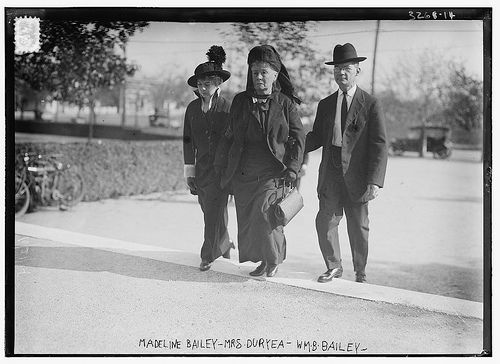 Madeline Bailey -- Mrs. Duryea -- WM.B. Bailey (L...
In terms of milestones 1996 provides a big one. It marks the 100th
anniversary of the assembly and sale of the first true 'production' vehicle,
the 1896 Duryea. It's this event that is considered the birth of the American
auto industry.
Even the Duryea brothers could have not imagined that their initial
13-car production run in 1896 would create an industry that would produce
millions of vehicles by the end of the 20th century.
Looking back the Duryeas two-seat vehicle, called the Duryea Motor
Wagon, featured a two cylinder, in-line, water-cooled gasoline engine that
produced an earth-shaking six horsepower. The body panels, wheels and
the axle were all made of wood, and the frame from steel angle. The Motor
Wagon weighed 700 pounds and cost $1,500.00, a big price...