The french revolution- "The Terror was the triumph of violence over ideals"
The ideals commonly associated with the French revolution of 1789-1794 are "Liberty, Equality and Fraternity". Articles like the Cahiers and the "Declaration of the Rights of Man and the Citizen" published early in the revolution were inspired by the Enlightenment and growing dislike of the Ancien Regime and the king's oppression.
They are clear demonstrations of the ideals of the revolution- mainly being equality before the law, freedom of speech and a united France.
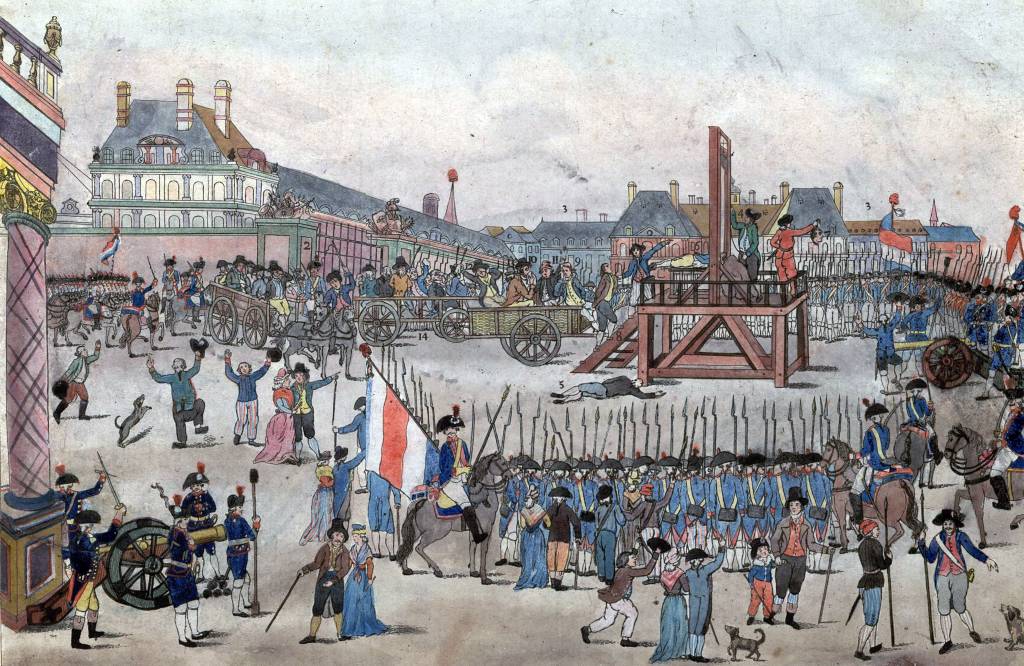
In the search for achieving these ideals however, violence was used often to an amazing extent as the revolution became radical. Although at first violence was used to progress France by crushing counterrevolutionaries and opposes of the republic, the time known as the Terror was the peak of radicalism and resulted in the triumph of violence over these ideals. Laws such the "Law of Suspects" and "Law of Prairial" were deliberately created to bypass the Declaration of the Rights of Man and Citizen. The Terror and the violence associated with it became a form of political oppression as Robespierre rose to the point of dictatorship, thus crushing the ideals of the revolution
The Philosophes were the voice of the Enlightenment and essentially that of the ideals that triggered the beginning of the Revolution. According to Townson "Their aim was to apply rational analysis to all activities... They were very much in favour of liberty- of the press, of speech, of trade and of freedom from arbitrary arrest." The French Revolution aimed to create this liberty within the social classes by destroying the absolute monarchy and establishing a government of the people, for the people.
The Cahiers collected before the estates general also voiced the main ideals of the revolution. They contained ideas of equality before the law, economic freedom, fiscal equality and they echoed the catchcry...
Reviews of: "The french revolution- "The Terror was the triumph of violence over ideals""
:
More The French Revolution
essays:
Reign of Terror was during the French Revolution.
... the beginning of the Reign of Terror. Leaving aside the democratic ideals to which the original revolution ascribed, and which were summarized by the Declaration of the Rights of Man, the ...
The French Revolution and the Terror
... judicial and social equality suddenly became violent and extremely bloody towards those whose opinions differed from the revolutionary leaders. If the revolution protected the fundamental rights as laid out in the Declaration of the Rights of Man and the Citizen how ...
The French Revolution: Assess the view that the main cause of the French revolution was popular discontent.
... Montesquieu and especially Rousseau. The document "The Rights Of Man" for example were based on many of Rousseau's ideas. In conclusion, I disagree with the view that popular discontent was the main reason for the French Revolution, rather ...
Why do Marxist historians see the French Revolution of 1789 as 'Bourgeoisie'?
... why the Marxist historians would see the French Revolution of 1789 as 'Bourgeoisie'. It seems to me that the whole ethos of Marxism incorporates Sobouls and Lefebvres ...
Why did the French fail so often in military battles around the period of the French Revolution? A look at France's military tactics from the 1400s-1800s.
... disarray right before the revolution in the 1790's. The monarchy was heavily separated from the common people, and military leaders were not well chosen: they instead were appointed by being friends of the King. The tactics ...
The Significance of the French Revolution
... Declaration of the Rights of Man and Citizen, France was introduced to a constitutional government, and the ideal of democracy were unleashed upon the nation. Many critics have argued that in all the bloodshed, terror, and gore of the French Revolution ...
The major causes of the French Revolution
... of the French Revolution were the disputes and inequalities between the different types of social classes in French society, and the financial problems, facing the French government, during the year of 1779. The French Revolution of 1789 ...
The Rights of Man: French Revolution
... a man's conscience is but a subtle hindrance when justifying one's actions. The Revolutionary leaders, thus, found themselves in a predicament when fighting for rights and freedoms of only a select group of French citizens. This ...
Superb!!
Very well done. I like the details. The bibliography was perfect. Hope to see more essays from you.
2 out of 2 people found this comment useful.