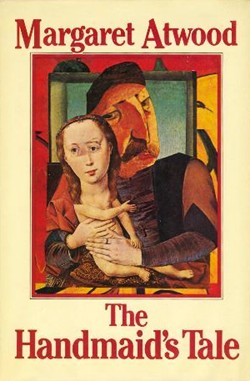
"The Handmaids Tale" by Margaret Atwood - exploring the limitations imposed by gender, power and religion
Task: In the text The Handmaid's Tale, Atwood explores the limitations imposed by gender, power and religion. Discuss.
In Margaret Atwood's A Handmaid's Tale, Atwood explores the limitations of society imposed by gender, power and religion. In the book, the male species is the dominant gender. The have a lot less restrictions, and many more freedoms. In one way they have the ultimate power, but in another, the females are in control. Power is divided into classes, or positions. Commanders and their wives seem to hold physical power, but handmaids hold the mental power. Although they can't think the way they want to, they can slightly alter someone else's wants and needs. Religion is the main source of limitations in the book. Their whole life is based around the bible, but only some bits, not all. They are forced to believe in Gilead's beliefs, and if they don't, they will suffer serious consequences. These three things limit the people enormously. They must think the way that is expected, act like they're supposed to, and even speak the way they are expected to speak.

Firstly, Atwood explores the limitations caused by gender. It is quite clear to see that the male gender dominates in the aspect of power and control. However, they seem to be more vulnerable than the women. A flash of a woman's eyes can melt a thousand hearts. Men have the freedom to go out, socialise, and have sex. They aren't expected to be fully covered, and they can do basically whatever they feel like. The handmaids however, are expected to dress in full length dresses, exposing no skin, avoid eye contact and verbal contact, forbidden to have any relationships with anyone (including friendships), and are considered as only "breeding tools". If they are unsuccessful at that, their...
Reviews of: ""The Handmaids Tale" by Margaret Atwood - exploring the limitations imposed by gender, power and religion"
:
I am currently writing an essay on the theme of power and control in The Handmaid's Tale, and I found this essay quite helpful. However, I think it would be better if the writer used quotes to back up some of the statements and examples in this essay. Other than that, good job!
i love how you explain the author meaning on the view of gender, power and religion. its a well put essay.I've been helping my friend on this same essay and you seem to help me explain to him better.
some very good points raised, although more quotes and literary techniques would greatly strengthen the argument :)
More European Literature
essays:
Paradise Lost by John Milton: Exploring the Themes of Mankind's Great Fall
... is forced to punish them. Through punishing him he forces humankind to experience ... Adam and Eve should have accepted God's order not to eat the forbidden fruit. Instead, they disobeyed him, undermining his power over them. Furthermore, Adam and Eve both defy the hierarchy ...
In the Miller's prologue, Chaucer informs us thar the Miller 'tolde his Cherles tale in his manere.' Explore the ways that the Miller's character is reflected in the Miller's tale.
... characters. this shows what the Miller thinks of those who have been 'cokewolded.'through Absolon the Miller recives another oppertunity to idolise Nicholas. the comparison between nicholas' 'gay sautrie' and Absolon's 'smal rubible' and 'gentil and smal' voice shows again ...
Themes in the novel 'The Handmaids Tale'
... passport'. Gileads government has taken away freedom to and given freedom from(Atwood, 33) to the handmaids. They regulate what they can and cannot know, forcing them ...
A Medieval Pilgrimages: "The Canterbury Tales"
... places to go and things to do at the site of their pilgrimages. Political, cultural and economic power influenced ...
The Franklin's Interruption of the Squire in the Canterbury Tales
... with his 'gentilly' (674) or 'gentillesse' (694). If we are to believe what the Franklin is saying, that he admires his gentillesse ...
The Miller, this essay is about the book, The Canterbury Tales, by Geoffery Chaucer. The Miller is a certain character and this essay tells of his part in the book.
... is somewhat blasphemous and ridicules religious clerks, scholarly clerks, carpenters, and women. The Miller was a drunken comedian, just trying to get a reaction out of the other pilgrims. During the story telling there is a lot of tension between the ...
'Othello' by William Shakespere. Explore the character and role of Iago in 'Othello', focusing particularly on his dramatic impact in Act 3 Scene 3.
... the main characters, other than Othello, is very conniving and egotistical. He is very sly in his ways and he will do anything to be more powerful, not ... he gives us so many reasons none can really be believed. He would appear to be a man with so many psychological problems in terms ...
Compare the morality of the values displayed by societies represented in "The Great Gatsby" and Mrs. Dalloway.
... its fragility. The consequences of unwilling conformity are always going to be great. Clarissa is a survivor. Her reaction to Septimus' suicide ... past and the present through memory and present events and I believe that the clocks signify the connection. Concurrently perspectives are being expressed ...
The Handmaid's Tale
Yours is a wonderful essay on Margaret Atwood's classic story. You've done a great job of exploring the limitations imposed by gender, power and religion in "The Handmaids Tale." Superb effort!
10 out of 10 people found this comment useful.