J.S. Mill's "On Liberty".
Opinion,
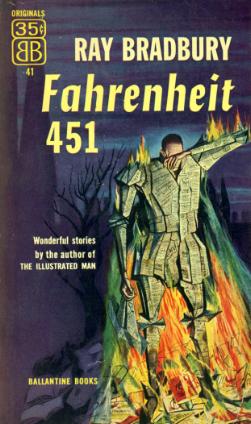
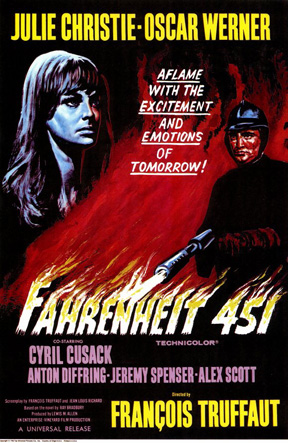
Imagine a world where one wakes up to an unquestioning society, where books are burned and opinion suppressed. Such a society is described in Ray Bradbury's Fahrenheit 451. Ray Bradbury talks about a hypothetical society where freedom of speech is a myth and the minorities who disagree are killed. J.S. Mill however, disagrees with societies such as Ray Bradbury's in his book On Liberty, Of The Liberty Of Thought And Discussion. If J.S. Mill were to exist in a society such as Fahrenheit 451 he would probably not agree with it. In addition to J.S. Mill's book, Emily Dickinson and her poem Much Madness is Divinest Sense complement the same opposition to societies such as the one Ray Bradbury has depicted.
J.S. Mill believes that all opinions should be heard. (On Liberty, pg.76) "If all mankind minus one were of one opinion, mankind would be no more justified in silencing that one person than he, if he had the power, would be justified in silencing mankind." J.S. Mill is expressing that neither of the two parties has the right to suppress the others opinion, not even the majority. The majority could be right, but then again so might the minority, which is why neither can be justified in silencing the other. Should one side be absolutely right then it could be justified in silencing the other.
The second argument made by J.S. Mill is why no one can be justified in silencing opinion. (On Liberty, pg.77) "Those who desire to suppress it (opinion), of course, deny its truth; but they are not infallible." Although someone might say another's opinion is wrong they are still capable of error and therefore the opinion may in fact be right. To deny the hearing of an opinion is to assume that one's opinion...
More Modern Philosophy
essays:
Existentialism. Mentiones Dostoyevsky
... recognition of continual, absolute freedom of choice (Olson). It is through these senses that people perceive responsibility. Existentialists regard responsibility as personal and ...
The Life & Philosophy of Friedrich Nietzsche: Timeline
... If one showed the smallest bit of weakness or morality, he would be killed by the stronger Overman, and taken over. Thus, the advancement of The Master Race (Nietzsche's "Master Race" will be discussed later). "Not mankind, but superman is ...
Heredity, the Environment, and Development
... genetic complement of an individual, like having a recessive gene for color blindness; polygenic which is many genes influencing a trait but no one gene has a major effect (hundreds of genes influence IQ and personality). Correlations ...
Hume
... to freedom. As the Egyptians were crossing the sea it closed it's gates and let them drown with in the waters of the sea. In justifying whether Hume would discredit this miracle he would definitely see how one may ...
Locke study notes: Used for presentation.
... Law of Nature. Locke proposes that this is where one must derive our political power as this is the "state of perfect freedom to order their actions and dispose of their possessions and persons as ... as much as he can, to preserve the rest of Mankind." The concept of a ...
Was Locke misguided in trying to account for all the legitimate functions of government in terms of "the preservation of property"?
... that one must derive our political power as this is the "state of perfect freedom to order their actions and dispose of their possessions and persons as ... , ought he, as much as he can, to preserve the rest of Mankind." The ... . However, the overwhelming sense that one gets from reading Locke is that he ...
Locke And Rouseau Relationship between the "Hand and the Glove" theory
... where mankind has the freedom and right to do as they please, we must have certain laws. Without these laws, the world would be an utter chaos. To have laws, you must have a government. The purpose of a government is ...
Prove It I dare YOU´. Personal essay on belif in God's existence
... the opposite beliefs that I have originally believe in. In school and in books I learn about philosophers like Socrates, Plato, Humes, Renè Descartes, and plenty of other philosophers. Philosophers like these shape concepts and open up new possibilities. One ...