From Realism to Modernism
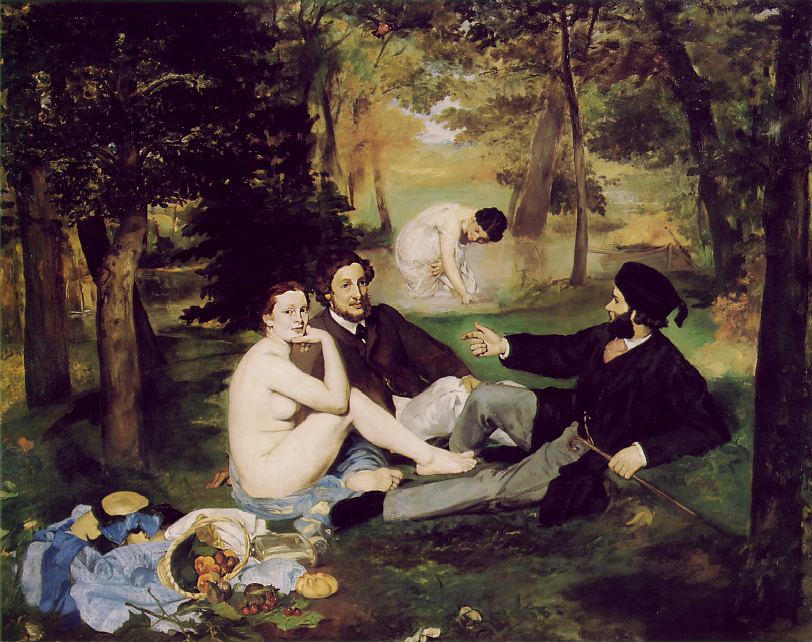
Le déjeuner sur l'herbe Edouard Manet, 1863.
Le déjeuner sur l'herbe ("The Luncheon on the Grass"), originally titled Le Bain ("The Bath"), is an oil on canvas painting by Edouard Manet. It was painted between the years 1862 and 1863 and measures 208 by 264.5 cm. The juxtaposition of a female nude with fully dressed men sparked controversy when the work was first exhibited at the Salon des Refusés in 1863. The work is now in the Musée d'Orsay, Paris.
In the foreground, three characters are seated on the grass: a naked woman and two men dressed like dandies. The woman, whose body is starkly lit, looks frankly in the direction of the viewer. The man on the right is wearing a flat hat with a tassel. The men seem to be engaged in conversation and totally ignore the woman. In front of them, the clothes of the woman, a basket of fruit and a round loaf of bread are displayed as in a still life.
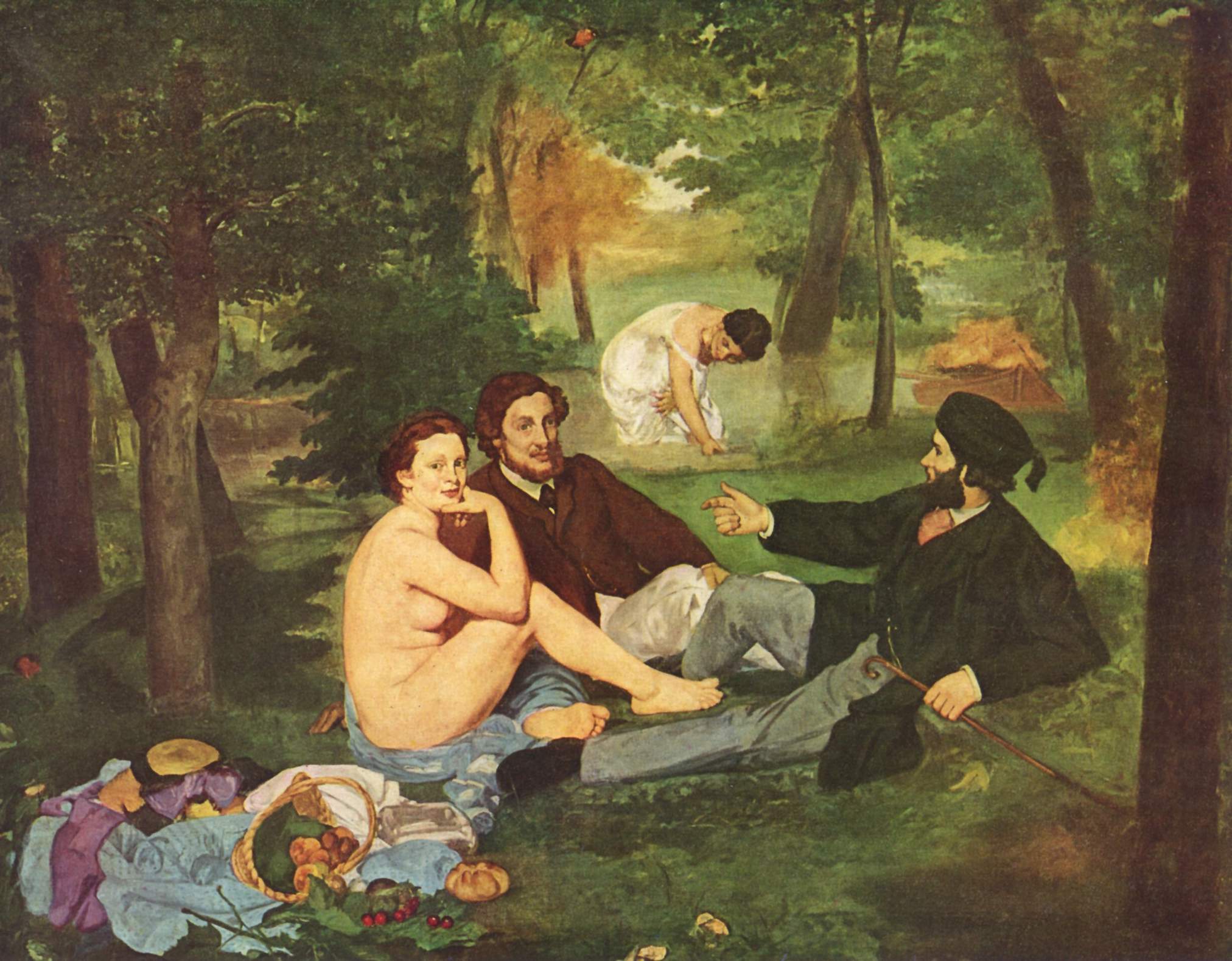
In the background, we see another woman, draped in an almost transparent cloth, bathing in a small pond. She is too large in comparison with the figures in the foreground and seems to float. The backdrop is painted roughly and lacks depth: one gets the impression that the scene doesn't take place outside, but in a photographer's studio. This impression is reinforced by the use of broad "photographic" light, which casts almost no shadows: in fact, the lighting of the scene is inconsistent and unnatural. One can also note that the sort of hat the man is wearing was normally only for indoor use.
Realism is commonly defined as a concern for fact or reality and rejection of the impractical and visionary. However, the term realism is used, with varying...
More Works of Art
essays:
The Dynamic from Conceptions to Experiences in Early Art and the Characterization of Greek Art in the Classical Era.
The Venus of Willendorf is one of the earliest sculpted figures, dating from between 28,000 and 23,000 BC. She is a limestone sculpture, about four and three-eighths inches tall, and her distinguishing features are highly exaggerated: enlarged breasts and stomach, wide hips, and defined pubic area. ...
The art of Italy and Northern Europe from 1300 to
The Art of Italy and Northern Europe from 1300 to 1520 The years between 1300 to 1520, commonly known as the Renaissance, was an era of extraordinarily advanced achievements made in the art world. Techniques that began to be utilized at this period of time made the artworks surpass those of any ...
What was modern about De Stijl?
... , red , black , yellow and grey Van der Leck also came from conventional realism, which he was taught at the Amsterdam Academy. Some of his work ... after, following an edition dedicated to the inspiring founder. What makes 'De Stijl' modern is their attempt to abolish form and the use of pure colour. ...
Art- The Ink to Political and Historical Blueprints; stimulus: History is a blueprint for the future
... after the fall of the city. Unlike Goya's subtle, even suave, realism of the Family of Charles IV, the method here is coarse and ... the statements in relation to political art, from history to the present "modern" world - as society continues to change. © Iris Frank (2006) APPenDiX 1) Francisco ...
"The Lady of Shalott" by William Holman Hunt: Fallen Woman to Feminist
... Whether The Lady of Shalott represents a fallen woman or a feminist, the realism of the piece conjures thoughts not about the lines of a poem ... tale mentioned (Dillon, par. 2). In a time that was overwhelmed by modernization and industrialism, Hunt recreated a revival scene of an Arthurian legend as ...
Georgia O'Keeffe's Grey Hill Forms
... to see what I see of flowers.' In a kind of selective realism, she is more concerned with the essential identity of things rather than ... -objectivity, and thus was one of the considerable contributors to visionary modernism. In Grey Hill Forms, Georgia O'Keeffe begins with the traditionally painterly ...
The Violence of Caravaggio
... norms of his time. The artist's taste for violence and realism was not located in his subconscious--however offensive his personal behavior ... Caravaggio, one of the most innovative and provocative painters of early modern Europe. Varriano, John. "Caravaggio and violence." Storia dell'Arte. 97 (1999): ...
"Modernist styles such as impressionism, post impressionism, cubism and expressionism challenged conventional ideas in art making and the ways in which art was thought about
... d'Avignon, through his rejection of Impressionist ideals such as realism, perspective, harmonious composition and correct depiction of human anatomy, his ... emerge in the mid-nineteenth century. There were many movements within Modernism; but none challenged conventional ideas about art to the same ...