Zen Buddism.
Zen is a branch of Buddhism, that is practiced in China, Japan, and Korea. It incorporates the Taoist thought, and stresses the role of meditation and pursuing enlightenment. Traditionally, Zen traces its roots back to Indian Buddhism, where it was known by "dhyāna", a Sanskrit term for meditation. This name was transliterated into Chinese as "Chán" was later transliterated into Korean as "Seon", and then into Japanese as "Zen."
According to these traditional accounts, an Indian monk named Bodhidharma brought Zen Buddhism to China in the fifth century CE. Later, Japanese monks studying in China learned of Zen and brought it back to Japan around the seventh century.
The history of Zen begins in India. In Buddha's lifetime, yoga as a practice in the concentration of the spirit was widespread. It is in the nature of yoga to concentrate the spirit on one point, the achievement of serenity through seated meditation. The yoga methods of the day were limited at this time to restrictions on what was to be eaten, fasts, and certain vows such as the vow to remain standing on one leg for a long period of time. Through such practices and many exercises, the yogi trained himself and was in the control of the slightest movement of his own spirit.
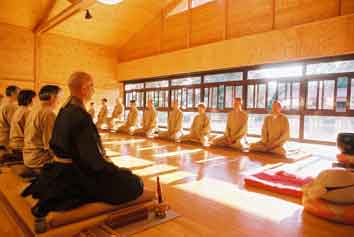
Buddha practised this kind of yoga for twelve years from the moment that he decided to give up a routine life. He visited saints and interviewed wise men, travelling to the four corners of the country. But in the end Buddha did not find in Yoga any answer to two essential questions, what is man, and how should man live?
Buddha gave up ascetism, sat down quietly, crossed his legs and observed his breathing. During the dawn of the eighth day of Zazen he attained a...
More Buddhism
essays:
This essay is a brief history and background on Budhism.
... Buddhism represents a movement within the Buddhist religion that stresses the practice of meditation as the means to enlightenment. Zen and Chan are, respectively, Japanese and Chinese attempts to render the Sanskrit word for meditation, dhyana (Coomaraswamy 94). Zen's roots ...
Buddhismen Innehållförteckning Buddhismen 1 Innehållförteckning 1 Buddhismens historia 1 Buddha
... – Asien i Tibet, Kina, Korea och Japan, Den kallas också för sanskrit buddhism för grundskrifterna var på sanskrit, dessa har nu översatts till lokala språk ... Den kanske mest kända är Zen (som betyder meditation). Zeninriktningen härstammar från Kina men är nu stark i Japan och i väst. Zenbuddhister ...
Buddhismen Innehållförteckning Buddhismen 1 Innehållförteckning 1 Buddhismens historia 1 Buddha
... – Asien i Tibet, Kina, Korea och Japan, Den kallas också för sanskrit buddhism för grundskrifterna var på sanskrit, dessa har nu översatts till lokala språk ... Den kanske mest kända är Zen (som betyder meditation). Zeninriktningen härstammar från Kina men är nu stark i Japan och i väst. Zenbuddhister ...
This essay discusses one of the sections of Buddhism.
... 't so stringent and monkish. These rituals included aspects of Indian Buddhism. Mahayanists followed the Indian style of worship, also known as puja, and they ... , are taken from the book Buddhism, by Donald K. Swearer, Ph.D. Many pupils were studying meditation under the Zen master Sengai. One of them ...
Buddihism
... in Korea, China, Japan, and Tibet. The three most prominent schools are Pure Land, Chan or Len, and Tantra. Mahayana schools stress that ...
Field Study in a Buddhist Temple
... the meditative state, he/she is one with every emotion allowing him to be one with the universe and temporarily reaching enlightenment, Nirvana. The chanting of the Juseige during service allows you to temporarily reach this ultimate goal of Buddhism. The ...
Buddhism and the seven dimensions
... in accomplishing this then they are said to have gained enlightenment. In terms of mass rituals, Buddhism maintains a plethora of ceremonies dealing with both the 'Sangha ... wisdom and experience, which is gained through methods such as meditation. This in turn indicates that a large emphasis is placed ...
Buddhism - History and Characteristics.
... caused by desire, that suffering ceases when desire ceases, and that enlightenment obtained through right conduct, wisdom, and meditation releases one from desire, suffering, and rebirth." (dictionary.com, 2004) Buddhism teaches one to be a realist, to understand that the world ...