Comment: you should have e-mail submissions so that charts and pics can be part of the work
Procedure
1. Prepare 1 molar NaOH solution for liquid feed. Prepare 2 mol% CO2 gas feed.
2. Record base feed conductivity (time = 0)
3. Start vapor feed up the column.
4. Start liquid feed down the column. (Turn on pump 2 after opening valves 6 and 7.)
5. Let column reach pseudo-steady state. Monitor vapor flow rate using anubar. Measure bottoms flow rate by colleting bottoms output for 30 seconds. Monitor pressure drop across the column using anubar.
6. Record conductivity of feed and bottoms streams every two minutes.
7. Take 1 mL samples of entering and exiting vapor streams. Use gas chromatography to analyze CO2 composition in the entering and exiting vapor streams.
8. Change the liquid flow rate after 40% carbonation and continue to record data as specified above.
ChemCAD Simulation
Table 1: Results from ChemCAD output and calculations of CO2 bottoms weight fraction and %recovery
G L hM F wF D wD B wB recovery
Effect (m3/h) (L/h) (kg/h) (kg/h) (kg/h) %
 English: Macro photograph of coca-cola bubbles. De...
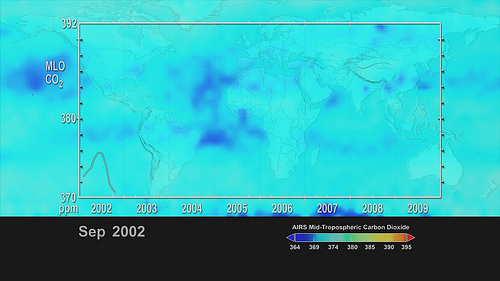 Global Carbon Dioxide 2002-2009, with Mauna Loa Ca...
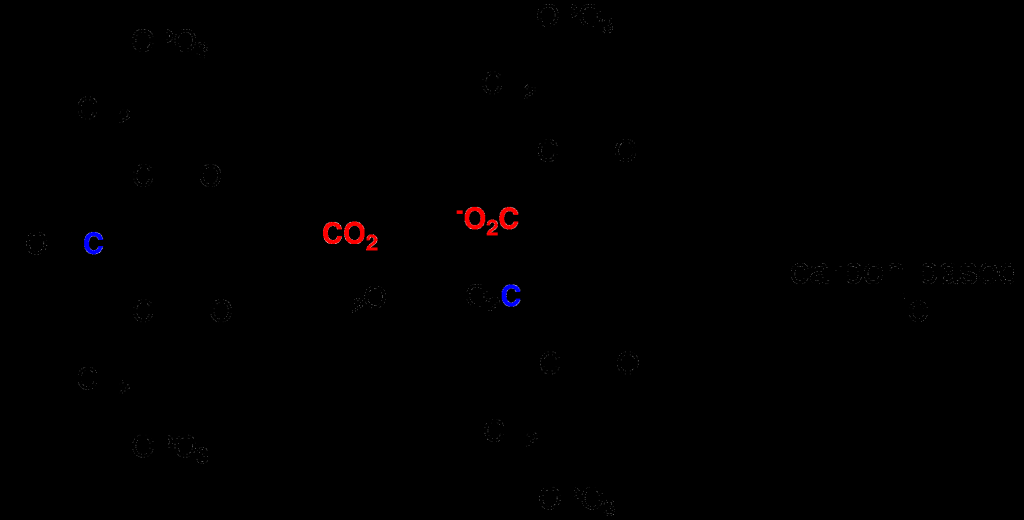 English: chemical reaction for CO2 fixation
Avg. 350 400 0.5 451.149 0.03047 445.336 0.0079 419.337 0.02438 74.39
G 450 400 0.5 580.048 0.03047 573.528 0.00953 420.044 0.02907 69.09
L 350 500 0.5 451.149 0.03047 445.049 0.00772 523.005 0.01971 75.00
GL 450 500 0.5 580.048 0.03047 572.632 0.00800 524.322 0.02497 74.08
hM 350 400 0.4 451.149 0.03047 446.092 0.01110 419.545 0.02096 63.98
hM 350 400 0.3 451.149 0.03047 446.853 0.01506 418.784 0.01675 51.03
hM 350 400 0.2 451.149 0.03047 447.872 0.01962 417.765 0.01187 36.08
The weight fraction equivalent of carbon dioxide in the bottoms is calculated from a mass balance on carbon dioxide. The mass equivalent of carbon dioxide in the bottoms is equal to the entering mass of carbon dioxide minus the mass...