The Age of Spiritual Machines, by Ray Kurzweil. This report gives a basic summary of a very technical book on A.I.
The first five chapters of this book provide the foundation for Ray Kurzweil to issue his predictions later in the book. It includes many theorems of physics and mathematics, so if one is not relatively familiar with them, it is possible to miss these essential principles. Nevertheless, his choice of words delineates some difficult concepts, making this tough but rewarding reading.
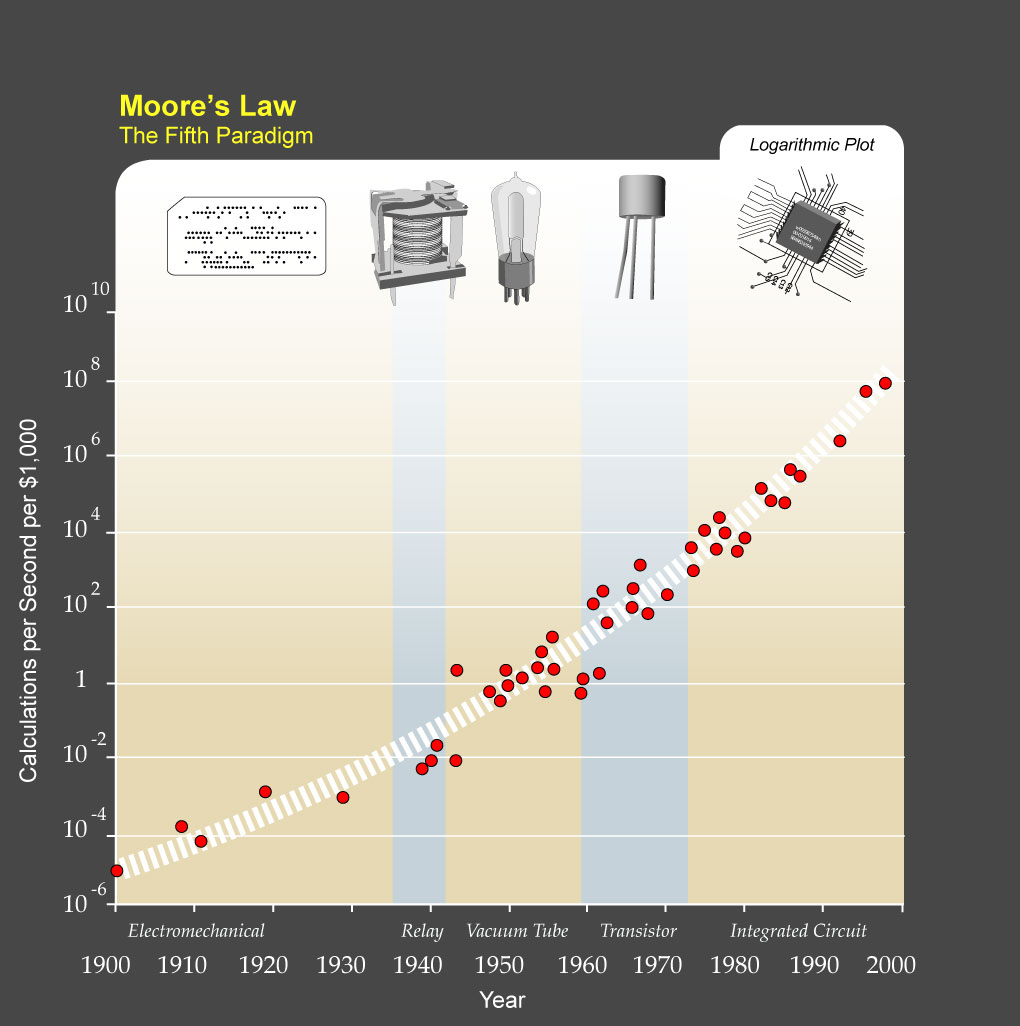
The first chapter ultimately leads up to the most important principle of the book, The Law of Accelerating Returns, which follows:
-An evolutionary process is not a closed system; therefore, evolution draws upon the chaos in the larger system in which it takes place for its options of diversity; and
-Evolution builds on its own increasing order.
Therefore:
-In an evolutionary process, order increases exponentially.
Therefore:
-Time exponentially speeds up.
Therefore:
-The returns (the valuable products of the process) accelerate.
Kurzweil uses this fundamental principle, in addition to others, to justify his many predictions.

The next chapter deals with the process of evolution. The evolution of intelligent beings has taken billions of years. But we have created something that is evolving at an extremely faster pace, technology. In a matter of about a thousand years, human-created technology has changed from nonexistent to essential to most people. So human intelligence, a product of evolution, is far more intelligent than its creator. And so, too, will the intelligence that we are creating come to exceed the intelligence of its creator; the Law of Accelerating Returns predicts it.
Alan Turing, a British mathematician who helped crack Germany's Enigma code during World War II, was on the forefront of artificial intelligence. He devised a test, duly called the Turing Test, in which a human judge interviews both a computer and one or more human foils using terminals. If the human judge is unable...
More Artificial Intelligence
essays:
Expert Systems Analysis.
... three principles for such design: 1. Design task-level representational primitives to capture important domain concepts defined by the expert. 2. Design explicit, declarative representation primitives. 3. Design representations on the same level of generalisation ...
Learning from Data
... following principle: The synaptic weights increases when both pre-synaptic and post-synaptic neurons are active simultaneously. An essential ingredient of supervised learning is the existence of a ...
Data Input/ Output Methods, Storage Devices and Computer Speed
... speed of a computer. The authors of Fundamentals of Information Processing state:The control unit executes an instruction in accordance with the electronic cycle, or pulses of the Central Processing Unit (CPU) clock. Each instruction takes at ...
Artificial Inteligence in the world today.
... sort of fruitless search. Slagle himself experimented with some mathematical theories of how to take into ... properties of ordinary physical things. Once when an early version of a block-building program was asked to find a new place to ...
This essay is actually my research based assignment of Artificial Intelligent Study regarding to "Imange Processing"....
... take place nowadays; one of them is in medical field. Based on current research, there ... treatment, outcome evaluation and medical education. Researchers' approach is a principled method firmly rooted in Bayes decision theory. They have adopted ...
Text Mining Research: A Survey
... Bag of words 1 - 2 - 3 - 4 - Widrow-Hoff - exponential gradient Liere and Tadepalli [38] Bag of words 1 ... In Principles of Data Mining and Knowledge Discovery, Second European Symposium, PKDD '98, volume 1510 of Lecture ...
Databases in my organization.
... use of databases, work will take longer to accomplish. Another great feature about having a database in place is that a record of all ... a relational database management system for building business applications with increased data protection. Information in one database is linked to another ...
Can Robots Have or Show Emotion?
... do because emotions are more than just the electro-chemical activity that takes place in our brains. However, robots could come close to our level of emotion through some of the ideas discussed above but if so it can be risky ...