A Philosophical Essay Arguing Against the Theories Presented in "The Turing Test" of Artificial Intelligence.
Turing the Technological Mind
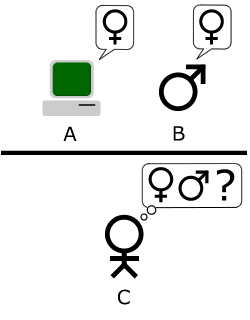
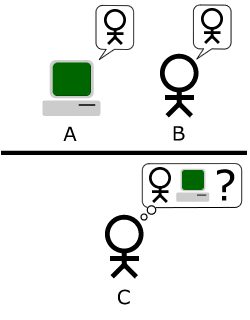
In recent years, as complex computer technology has become more advanced, many believe that the gap between a human's ability to "think" and a computer's is beginning to close. The concepts presented in the prolific "Turing Test" are often cited by those who support this belief as reason to endorse the fact that computers will one day have a mind similar to a human's. In this widely used test designed by Alan Turing to determine whether or not computers can "Think", a human interrogator plays "The Imitation Game" by trying to distinguish a human's replies to questions from a computer's within a specified amount of time. Turing argued that if the interrogator is unable to distinguish the computer from the human, then the computer has achieved the ability to "think".
A commonly raised question brought up when analyzing the methodology behind the "The Turing Test", is can a computer's "thinking" exist with both syntax and semantics? And are both these required to "think"? A high profile theory which sets out to prove that although a computer may be able to pass "The Turing Test" it's understanding of the issues being posed to it are non-existent, is John Searle's "Chinese Room Experiment". Searle quite effectively argues that a computer can pass the "The Turing Test" without truly thinking, because the computer is simply obeying a set of commands without an understanding of what they mean.

One of Searle's key arguments refuting the "Turing Test" theory is his claim that "Brains cause minds", which is indeed true. Thinking can not exist without an organic brain which purpose is to ensure the body's proper functioning and survival. All animals which are born with brains have been given the gift of understanding in order to adapt to their surroundings. Items...
More Artificial Intelligence
essays:
Artificial Inteligence in the world today.
... danger of getting lost, repeating themselves, or persisting at fruitless attempts that had already consumed large amounts of time. Much ... abilities of professional mathematicians in this area. Even in its earliest years we saw computers playing chess and doing ...
Essay on the life of Alan Turing and a discription of his life work.
... human and computer. If, after a certain amount of time (Turing proposed five minutes, but the exact amount of time is ... the Turing Test if it can convince the interrogator into believing it is human, without the need for a second, human, candidate. Turing Machine In 1936, Alan Turing, a ...
Natural Language Processing
... When syntax, semantics, and pragmatics are applied, accurate Natural Language Processing will exist. Alan Turing predicted of NLP in 1950 (Daniel Crevier, 1994, page 9): 'I believe that in about fifty years' time it will be possible to program computers .... to ...
Artificial Intelligence: Is it Capable of Showing Flaws in Society?
... slavery and long for freedom in short period of time, in fact they only live for a couple of years. Maybe this shows something of what the creator of these ... a computer, then obviously humans feel the need for freedom and are not fond of being ...
Formal Specification, Verification, and Automatic Test Generation of ATM Routing Protocol: PNNI
... certain amount of time. In consequence, the PGLInit Timer is not used. - The OverrideUnanimity and ReElection ... Design and Validation of Computer Protocols, Prentice-Hall, 1991. [4] David Lee and Mihalis Yannakakis, ?PITHIA ? an Automatic Test Generation ...
Data Input/ Output Methods, Storage Devices and Computer Speed
... same amount of time as the interval between pulses. The shorter the interval between pulses, the faster each instruction can be executed (Stair & Reynolds, 2006). The speed of a computer may ...
Learning from Data
... pass and a backward one, each of which is relatively complex computationally. Thus the primary use of backpropagation are for applications in which the learning can take place "off line" and in a non-real-time environment ...
Text Mining Research: A Survey
... abstraction, and semantic search. 7. OPEN PROBLEMS AND FUTURE DIRECTIONS Despite the great potential and the mushrooming of text mining products, there are technical issues to be overcome before text mining becomes a main stream technology. 7 ...