1. What is the difference between a financial asset and tangible asset?
A financial asset is an asset whose value arises not from its physical embodiment but from a contractual relationship: stocks, bonds, bank deposits, currency, etc... whereas a tangible asset has a physical existence, such as cash, equipment, and real estate.
2. What is the basic principle in determining the value of financial asset?
The basic principle to determine the price or value of a financial asset is the evaluation of the present value of all expected future cash flows.
3. What are the two basic roles of a financial asset?
The first basic role of a financial asset is to be a medium of exchange in transactions, that is to say to transfer funds on financial markets.
The second basic role of a financial asset is to redistribute unavoidable risks associated with cash flows, through its liquidity's function.
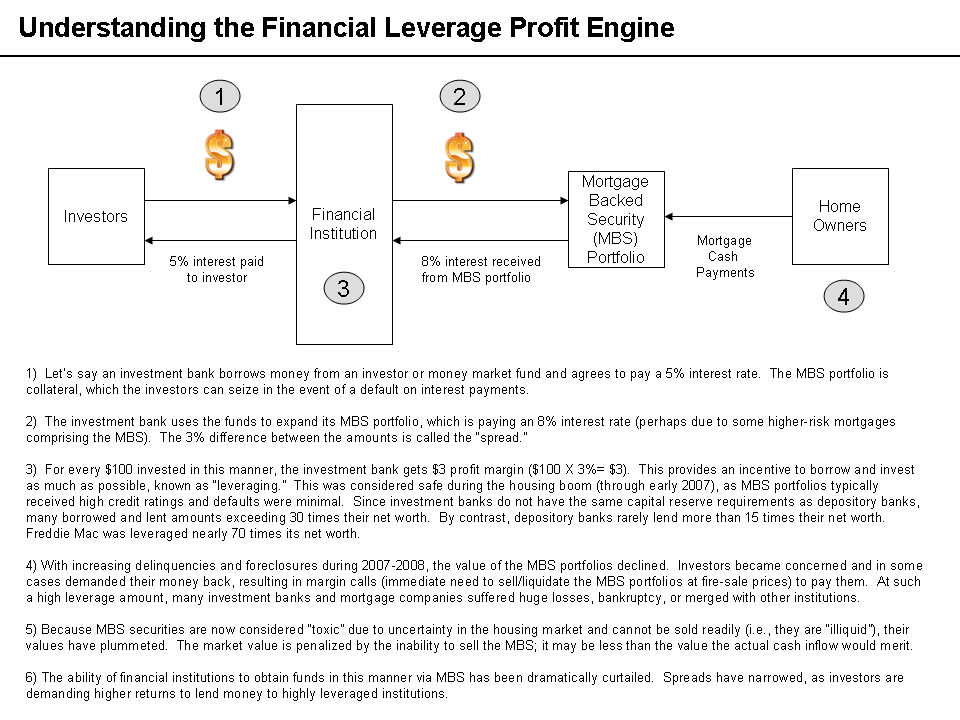 Understanding Financial Leverage
 A bond from the Dutch East India Company, dating f...
 Stock market of Brussels
4. Give three reasons for the greater integration of financial markets throughout the world.
Globally, the greater international integration of financial markets can be explained by the liberalization of trade and the cross-border capital flow. More deeply, it is the result of 3 factors:
- Technology, which has provided the communications infrastructure necessary for international financial transactions to be conducted.
- Customers, who are searching for the lowest cost products and services that have provided a ready market for international financial activities.
- Financial services providers (seeking a return on their capital, both financial and intellectual), who have developed the product engineering skills and innovation necessary to undertake cross-border financial activities.
5. Explain why derivative instruments are called derivative?
In chemistry, a derivative is a substance created from a primary compound, by chemical reaction.
In linguistics, it is a word that finds his origin in another one. (e.g. electric- electricity).